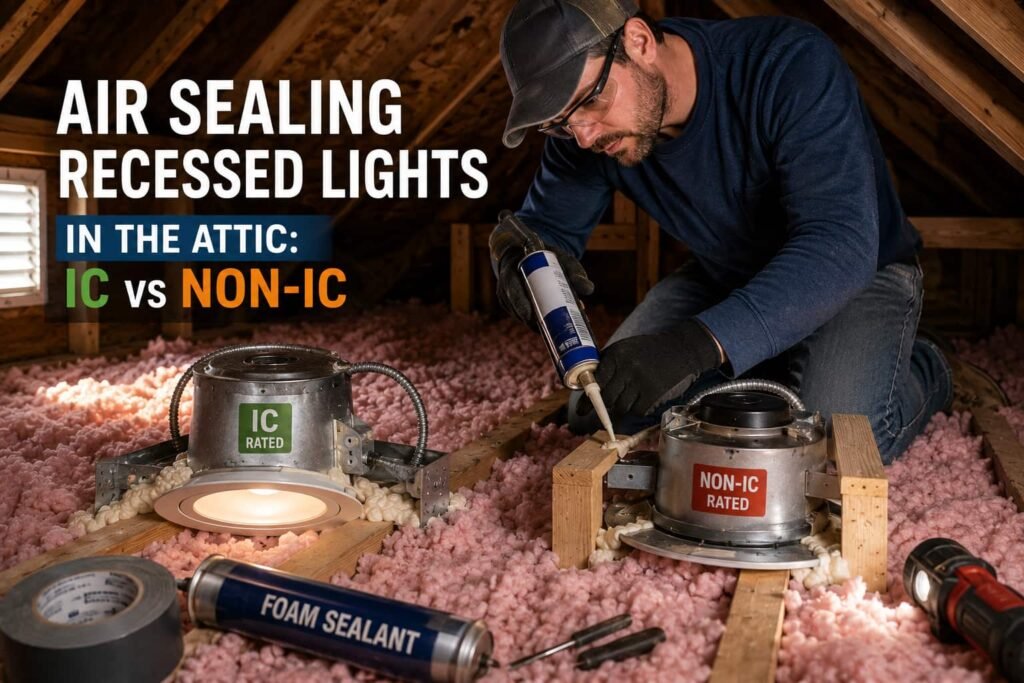
Air sealing recessed lights in the attic starts with the fixture's rating, not with a tube of caulk. A fixture marked Type IC is listed for insulation contact and can be sealed and covered. A non-IC fixture cannot: the National Electrical Code's baseline in Article 410.116 is that thermal insulation shall not be installed above a recessed luminaire or within 3 inches of its enclosure, wiring compartment, ballast, transformer, driver or power supply unless the luminaire is identified as Type IC. Never bury a can light of either kind.
That is the whole decision, and it turns on a label most homeowners have never looked at. Below is how to read it, what each answer allows, and where the job leaves your hands.
Why a can light is a hole with a heater in it
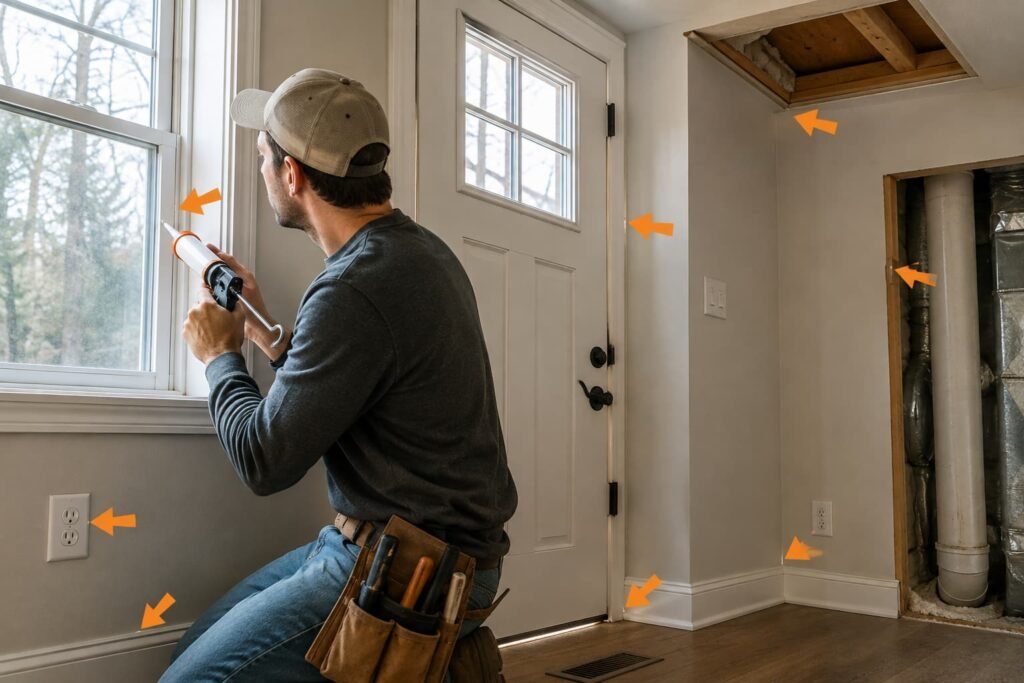
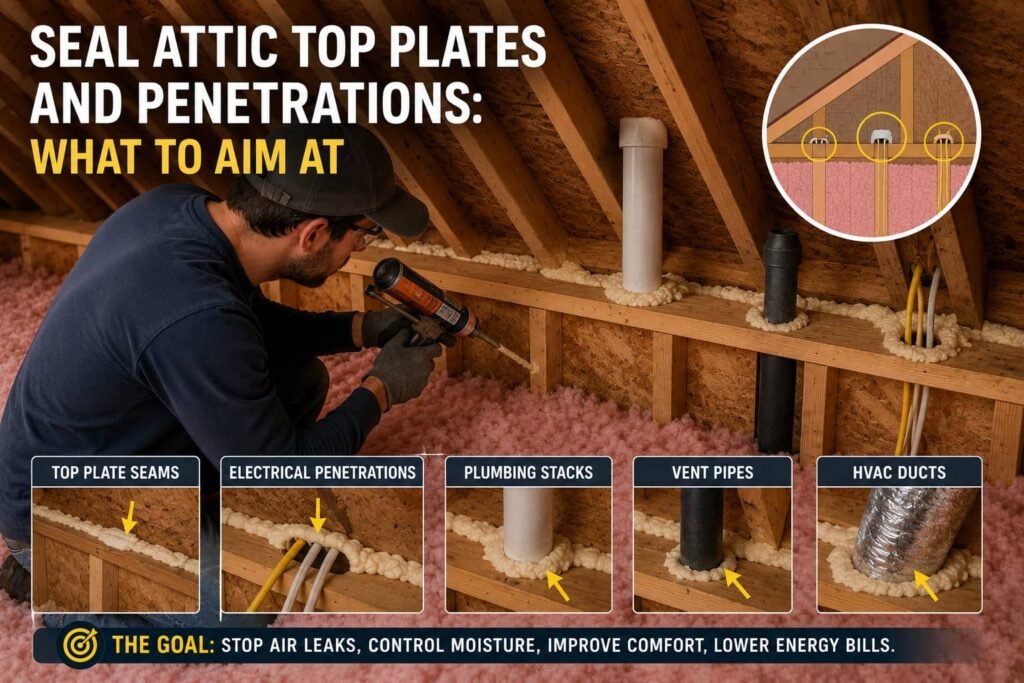
A recessed housing is not a sealed box. Older ones are perforated to let lamp heat escape, and every one of those slots opens into the attic through the ceiling plane. The Department of Energy's weatherization job aids list recessed lights alongside top plates, chases and plumbing vents as a penetration that has to be sealed to stop air and moisture moving between the attic and the conditioned space.
The heat is the second half. A hot fixture drives air upward through itself, so the leak grows when the light is on. That is why the fix has to satisfy two requirements at once, a seal against air and a clearance against heat, and why the wrong fix is worse than none. The pressure logic behind all of it is in our guide to where the leaks in a house actually are.
Before anything comes off the ceiling
Three stop conditions, and they come first.
- Combustion safety. Tightening a house changes how an atmospherically vented furnace, boiler or water heater drafts, and the Department of Energy's Energy Saver guidance describes how a reversed draft can bring combustion gases, including carbon monoxide, indoors. Working carbon monoxide alarms installed to the alarm manufacturer's instructions are the floor. A combustion safety test by a licensed HVAC technician, a licensed gas fitter or a certified energy auditor is the decision. This site prints no step for a gas line, a flue, a vent connector or a burner.
- Electrical. Switch the circuit off at the breaker before a trim ring or bulb comes out, and confirm it is dead. Nothing in this article opens a housing, a junction box or a splice. Any fixture showing browned insulation, scorched paper, a discolored socket or a thermal cutoff that keeps tripping goes to a licensed electrician, and knob and tube wiring anywhere in the attic stops the job entirely.
- The attic. Loose fill hides the joists and there is no floor between them, the space gets very hot, and flues can be hot enough to burn. If you find vermiculite, a light gray, pea sized, flaky mineral, the EPA advises leaving it undisturbed because it may contain asbestos.
Read the rating before you touch the insulation
The rating is a marking the manufacturer applied under the fixture's listing, and it is printed on a label on the housing. From the room, with the breaker off, remove the bulb and drop the trim ring: the label is usually visible inside the can. From the attic, the same label is often on the outside of the housing or on the junction box attached to it.
| What the label says | What it means | Insulation may touch it | What you may do from the attic |
|---|---|---|---|
| Type IC, or IC | Listed for direct contact with thermal insulation | Yes | Seal the fixture to ceiling gap, fit a cover, insulate over it |
| ICAT, or IC AT | Insulation contact and air tight | Yes | Same, with less leakage to start with |
| Non-IC, or no IC marking at all | Not listed for insulation contact | No | Build or fit a fire-rated enclosure, then insulate around it |
| Label missing or unreadable | Unknown | Treat as non-IC | Enclosure route, or ask a licensed electrician to identify the fixture |
Two field tells help but do not replace the label. IC housings are usually double walled with an air gap; older non-IC cans are a single perforated shell. If the label is gone, the conservative answer is the only defensible one.
If it is IC or ICAT: seal it and move on
This is the short branch. The Department of Energy's job aid for insulation contact rated recessed lights describes applying a bead of caulk to seal the gap between the fixture and the ceiling, then sealing the small holes in the fixture itself by installing a premade or commercially available cover over the fixture from the attic, with the edges of the cover sealed so conditioned air stops entering the attic.
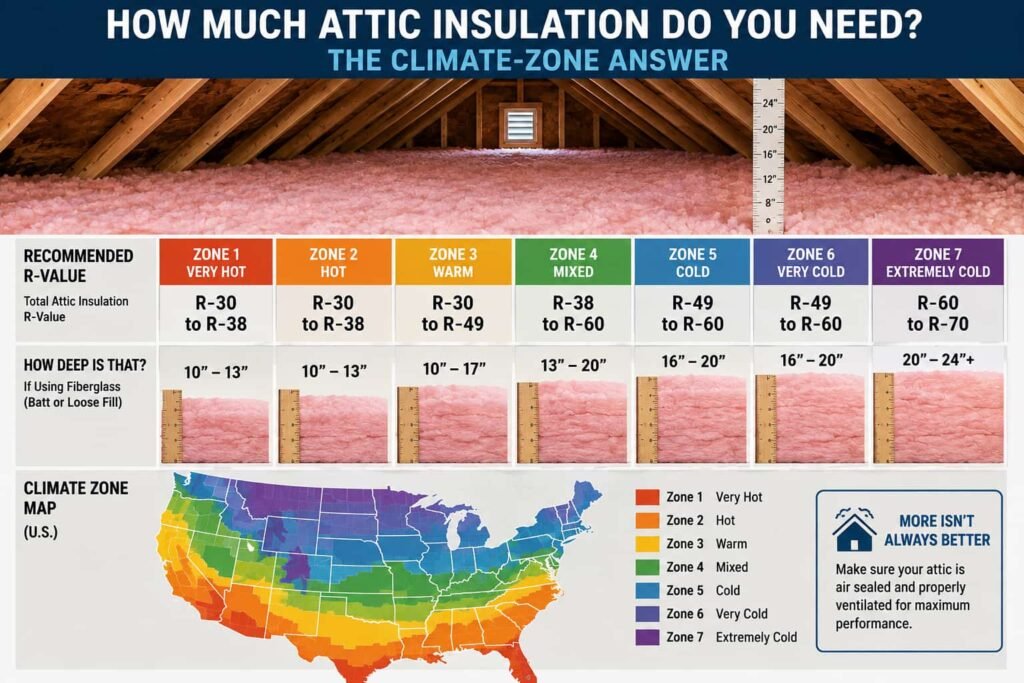
Work from above where you can, because the gap that leaks is the one between the housing and the drywall, and that is an attic-side joint. Use a sealant rated for the location, and keep it out of the lamp compartment and off the socket. Once the fixture is sealed and covered, insulation goes over it at the same depth as the rest of the attic floor, which is set by your climate zone rather than by the fixture. The zone by zone targets are in our guide to how much attic insulation you need.
If it is non-IC: the enclosure, as a spec
A non-IC fixture that stays in the ceiling gets a box around it. The Department of Energy's job aid 3-2, "Seal and Dam Around Non-Insulation Contact-Rated (Non-IC) Recessed Lights", gives the spec as a checklist, and it is worth judging any bought cover against the same four lines:
- The enclosure completely surrounds the fixture and is constructed of fire-rated materials, the job aid's example being 5/8 inch gypsum wallboard.
- It maintains 3 inches of clearance between the fixture, including its wiring, box and ballast, and the insulation, with the same diagram showing a half inch minimum to combustible material.
- It is free of insulation on top, and the job aid states the top of the box must be R-1 or less, so lamp heat can still escape upward.
- It is flagged so the next person in the attic can see where it is, and all edges, gaps and cracks of the enclosure, and the joint between the enclosure and the attic floor, are sealed with caulk, mastic, foam or another approved material.
Insulation then goes around the box, never over it. Sealing the box to the ceiling plane is what buys the air seal; the clearance inside is what keeps the fixture within its listing.
The code line, and its limit
Article 410.116 of the National Electrical Code is the US baseline quoted at the top of this page, and it is the sentence a contractor will cite to you. Two qualifications belong with it. States and local jurisdictions adopt code editions and amendments on their own schedule, so the edition in force where you live may not be the current one, and your inspector's reading governs. And a code clearance is a minimum, not a target: the fixture's own installation instructions can be stricter, and the listing is what the inspector checks against.
There is one shortcut that fails both tests. Stuffing insulation into the housing from inside the room traps heat against the lamp and the wiring, whether or not the fixture has a thermal cutoff, and it is not a method any of the institutional sources permit. Do not do it, and do not accept it from anyone working on your house.
No attic access, or too many cans to enclose
Where the attic cannot be reached, the room-side option is an air sealing LED retrofit module with a gasket that plugs into the existing lamp socket and seals against the ceiling. It changes what the fixture is doing thermally and it closes the trim ring gap, and it stays inside the boundary this site holds to, which is that a homeowner may plug something into an existing socket and nothing more. Replacing the housing, converting to a canless fixture, moving a junction box or touching a splice is a licensed electrician's work.
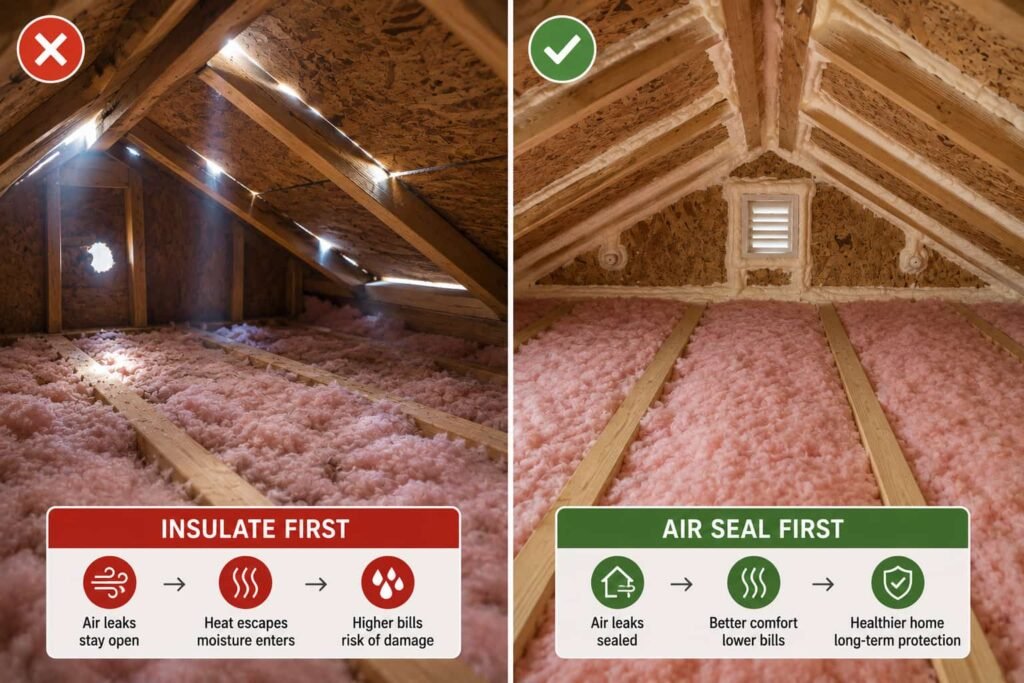
Count before you start either route. A dozen non-IC cans is a dozen boxes, each one sealed and flagged, and the honest limit is usually time and attic headroom rather than skill. Enclosures also have to be built before the loose fill goes down, which is one more reason sealing precedes insulating rather than following it.
Frequently asked questions
Can I put LED bulbs in and then cover the can?
No. The rating belongs to the housing, not to the lamp, and swapping a bulb does not change what the fixture is listed for. A non-IC housing with an LED bulb in it is still a non-IC housing under Article 410.116.
What if the label is missing?
Treat the fixture as non-IC. That is the assumption that stays inside the code clearance whichever kind it turns out to be. If you want a definite answer, a licensed electrician can identify the housing, and in an older house that visit is often worth booking anyway.
Are the fire-rated covers sold online acceptable?
Judge them against the DOE spec rather than the listing photo: fire-rated material, 3 inches of clearance on all sides of the fixture, a top that stays free of insulation and adds essentially no R-value, and edges that can be sealed to the attic floor. A cover that meets all four is doing the job the job aid describes. We name no product and place no affiliate link on this page.
How many recessed lights make this a contractor job?
There is no threshold anyone can publish honestly, because it depends on the number of non-IC fixtures, the attic's headroom and how much of the floor is already buried. What does decide it: any sign of past overheating, any knob and tube, any fixture you cannot identify, and any work that would open the wiring. Those are electrician work at one fixture, never mind twelve.
Sources
- US Department of Energy, State and Community Energy Programs, Weatherization Installer Job Aid 3-2, "Seal and Dam Around Non-Insulation Contact-Rated (Non-IC) Recessed Lights", DOE/GO-102023-5934, June 2024, read 2026-08-24 (fire-rated materials such as 5/8 inch gypsum wallboard, 3 inch clearance to insulation, half inch minimum to combustible, top of box R-1 or less and free of insulation, flagged, all edges sealed).
- US Department of Energy, Weatherization Installer Job Aid 2-5, "Seal Insulation-Contact Rated Recessed Lights", same series and date, read 2026-08-24 (caulk the fixture to ceiling gap, premade cover from the attic, seal the cover edges).
- National Fire Protection Association, NFPA 70 National Electrical Code, Article 410.116, clearance and installation of recessed luminaires, as summarized against the 2023 edition, checked 2026-08-24. Adopted editions and amendments vary by state and locality.
- US Department of Energy, Energy Saver guidance on backdrafting and combustion safety, accessed 2026-08-24.
- US Environmental Protection Agency, guidance on asbestos contaminated vermiculite insulation, accessed 2026-08-24.
Building code requirements vary by state and locality. Where this page names a code figure it is quoting a national source, and your local building department or inspector governs what applies to your house.