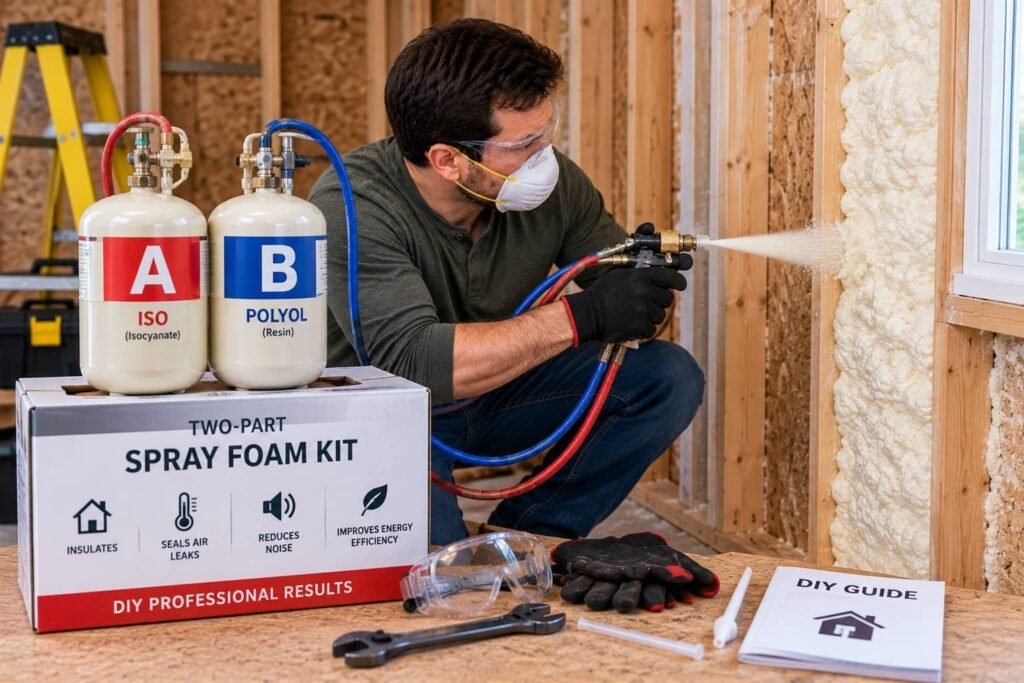
A two-part kit can seal and insulate awkward small areas that a foam board cannot follow, such as a rim joist bay full of pipes. It cannot safely insulate a whole attic or a whole basement, it will not work outside its temperature window, and it puts isocyanates into the air of an occupied house. Whether you should use one is decided by four things: temperature, pass thickness, respiratory protection, and who else is in the building.
We have not used any of these kits, and nothing on this page is a test result or a recommendation of a product. Everything below comes from manufacturers' own published documents, from the EPA, and from the industry body that trains professional applicators.
What these kits actually are
The EPA describes two-component low-pressure kits as products used by professional applicators largely for air sealant purposes or to fill holes and gaps, which are often called do-it-yourself products because they are sold to consumers. That sentence is the whole framing. The kit is a small-area sealing tool that happens to be available at retail, not a scaled-down version of the truck-mounted rig that insulates an attic.
The chemistry is the same as the professional product. Two liquids under pressure meet at a nozzle and react. Side A carries isocyanates. Side B carries polyols, catalysts, flame retardants and a blowing agent. The reaction is fast, it is exothermic, and it is irreversible. There is no adjusting it once it is on the wood.
The EPA also notes that homeowners who decide to use a two-component low-pressure kit or a one-component can should educate themselves on the safe work practices, techniques and precautions that professionals would use. That is the honest bar for this product: professional practice, without the professional's equipment or training.
Hazard one: isocyanates
This is the reason the row exists. The EPA's guidance on spray polyurethane foam states that exposure to isocyanates can cause contact dermatitis, skin and respiratory tract irritation, sensitization and asthma, and that isocyanates have been reported to be a leading chemical cause of work-related asthma, which it describes as a potentially life-threatening disease.
Sensitization is the part people miss. The EPA explains that some people become allergic to isocyanates and can then experience itching and watery eyes, skin rashes, asthma and other breathing difficulties. And then the sentence that should decide a lot of these projects: there is no recognized safe level of exposure to isocyanates for sensitized individuals.
The EPA advises that individuals with a history of skin conditions, respiratory allergies, asthma or prior isocyanate sensitization carefully review product information when considering these products and may want to consider safer alternatives. If anyone in your household is in that description, the answer to this article's question is already no.
Hazard two: the respirator is not a dust mask
The EPA's guidance for spray polyurethane foam installation says workers must wear protective equipment at all times to avoid exposure to vapor, mist, particulates and dust, including an appropriate respirator, chemical resistant gloves such as nitrile, and chemical resistant clothing. It also says to isolate the work site so isocyanates and other chemical vapors do not spread to other rooms or floors, to ventilate the work area, and that no one should be in the work site during installation except workers wearing appropriate protective equipment.
Manufacturers say the same thing in product terms. DuPont's published requirements for its Froth-Pak two-component foam system list protective clothing or impermeable coveralls with long sleeves so no skin is exposed, goggles or safety glasses, chemical resistant gloves coated with nitrile, butyl rubber, neoprene or polyvinyl chloride, and a respirator with an organic vapor and P100 cartridge.
A paper dust mask is not that. Nor is a cloth mask, nor a half mask with a particulate filter alone. An organic vapor cartridge respirator has to fit, which means facial hair at the seal is a problem, and cartridges have a service life. Read the specific document that came with the specific kit you are holding, because the requirements differ between products.
Hazard three: heat, and the reason thickness is a rule and not a preference
Foam generates heat as it cures. The Spray Polyurethane Foam Alliance describes the chemical reaction that creates polyurethane foam as exothermic, and states that closed-cell products installed at pass thicknesses exceeding the manufacturer's recommendations can generate excessive heat that gets trapped inside the foam. Its next sentence is the one worth quoting to anybody who says one thick pass is faster: in extreme cases, where closed-cell foam is applied at thicknesses several times the manufacturer's limits, it can generate enough heat to self-ignite the foam.
The same body says applicators should always follow the manufacturer's installation instructions on pass thickness and the time between passes, precisely to avoid damage from the exothermic reaction.
The manufacturer's number is a real number in a real document. DuPont publishes that its Froth-Pak 200 foam system can be applied up to 2 inches thick in one pass. Yours may say something different. Find the figure for your kit before you buy it, not while you are holding a live gun.
Hazard four: the temperature window is narrow and it is about the tank
This is where most kits fail in practice, and it catches people in autumn and spring as much as in winter. The chemicals have to be warm to meter and mix correctly.
DuPont's published guidance for the Froth-Pak 200 system states that for best results the tank contents should be at 75 degrees Fahrenheit or warmer, and that ambient and surface temperatures should be 65 degrees Fahrenheit or above. It also notes that the foam can be applied in cooler conditions provided the kit contents themselves are at least 75 degrees Fahrenheit.
Read those as two separate conditions. The temperature of the liquid in the tanks is not the temperature of the garage the tanks are sitting in, and moving a cold kit into a warm room does not warm the contents quickly. A kit sprayed cold gives poor yield, poor adhesion and off-ratio foam that may stay tacky and smell. Off-ratio foam is a mess to remove, and removal is its own exposure.
The gate after the foam: it does not stay exposed
Foam plastic is combustible and the model code treats it that way. Section R316.4 of the International Residential Code requires foam plastic to be separated from the interior of a building by an approved thermal barrier of not less than 1/2 inch gypsum wallboard, or a material meeting the acceptance criteria of both the Temperature Transmission Fire Test and the Integrity Fire Test of NFPA 275, unless a listed exception applies.
One exception is written around the rim joist. Section R316.5.11 permits foam plastic sprayed on sill plates and headers or installed in the perimeter joist space without that thermal barrier, subject to limits on thickness, density and flame spread index. That is one of the few places a homeowner-scale application of foam is contemplated by the code at all, and it is why the rim joist keeps coming up as the kit's natural use. We cover that assembly, and the exception's conditions, in our guide to insulating a rim joist by hand.
Everywhere else, plan for the covering. Code editions and amendments vary by state and locality, so confirm with your building department before you decide the foam is the finished surface.
The decision framework
Work down this list. A no at any line means the kit is the wrong tool for that job, not that you need a bigger kit.
- Is anyone in the household asthmatic, allergic, pregnant, elderly, very young, or previously sensitized to isocyanates? The EPA's own advice points such households toward safer alternatives. Occupants also have to leave during installation, which is harder than it sounds in a family home.
- Can you meet the respiratory, skin and eye protection the kit's own document specifies, including fit? If not, stop here.
- Can you hold the tank temperature and the surface temperature inside the published window for the whole job? In an unheated crawl space in November, usually not.
- Is the area small, reachable, and possible to isolate and ventilate? Kits suit bounded areas. Attics and whole basements are neither isolated nor easy to ventilate.
- Do you know the maximum pass thickness and the wait between passes for that product? If the answer is not a number from the manufacturer, do not spray.
- Do you know what covers the foam afterwards, and does your building department agree? Settle it before, not after.
- Is there a combustion appliance, a flue or a gas line in the space? Then a licensed trade is involved before anything is sealed, and foam never goes near a flue or vent connector.
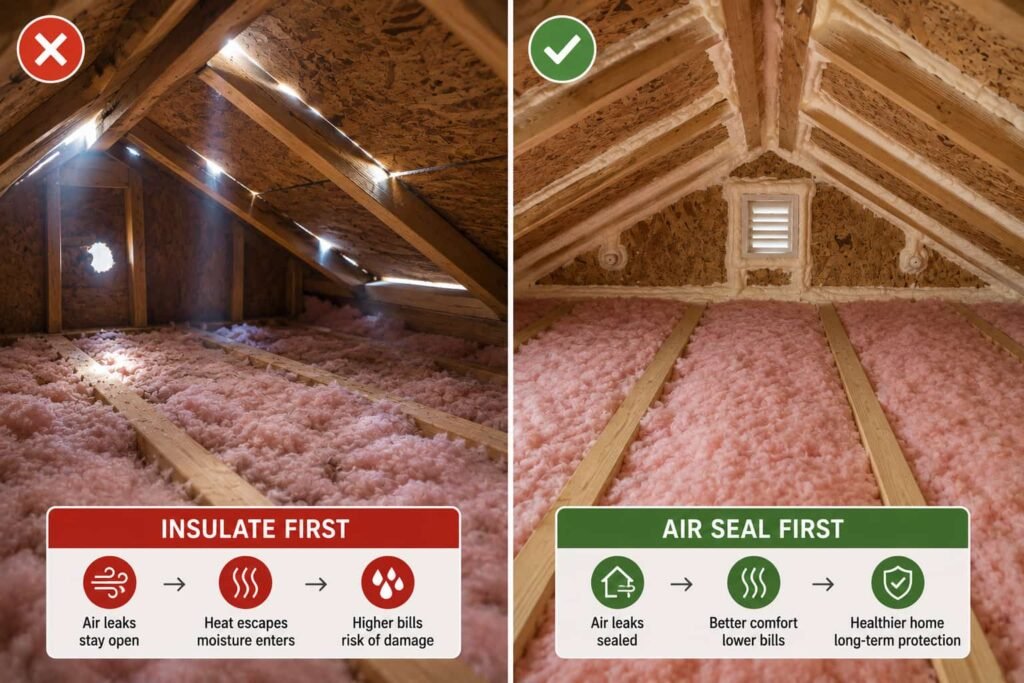
If more than one or two of those are shaky, the two honest alternatives are a professional installer, who has the metering equipment, the training and the respiratory program, or a different assembly entirely: rigid board sealed at the edges, or careful gun-applied canned foam and sealant at the joints. The order of operations does not change either way, and it is set out in why air sealing comes before insulation.
What a kit is genuinely good at, and what it is not
Good at: a bounded, awkward, reachable area where a rectangle will not fit and where a continuous air seal matters. Rim joist bays crowded with pipes and cables are the standard example. Sealing around a bulkhead. Filling an irregular cavity that a board cannot follow.
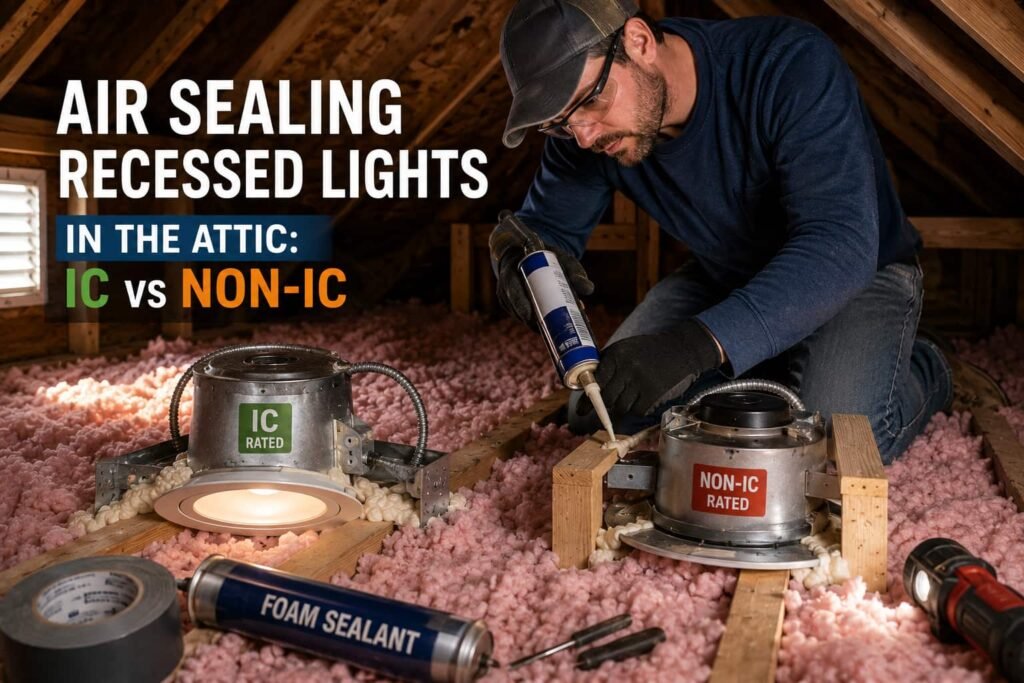
Not good at: anything measured in hundreds of square feet, anything overhead in an enclosed space you cannot ventilate, anything you cannot reach comfortably with both hands, and anything in an occupied house you cannot vacate. Attic air sealing at top plates and penetrations is better served by a gun-applied single-component foam and a caulk gun, which is the method described in our page on sealing top plates and penetrations from the attic.
Also not good at: replacing a diagnosis. If you have not yet found where the house is actually losing air, spraying is an expensive guess. Start with the whole house leak map in where the leaks actually are.
Frequently asked questions
Is a two-part kit the same chemistry as what a contractor sprays?
The isocyanate chemistry is the same family, which is why the health guidance is the same. What differs is the equipment. A professional rig heats, meters and mixes the two sides under controlled pressure, and the crew works under a respiratory protection program. A kit relies on tank pressure and on you keeping the contents inside the published temperature window.
Can I use one in an occupied house?
The EPA's guidance is that occupants vacate the premises during installation, and that nobody should be in the work site during installation except workers in appropriate protective equipment. Re-entry is a separate question the EPA tells you to treat with caution, and manufacturers publish their own re-entry guidance for their own products. Use the number in your kit's document rather than a number from a video.
What happens if the foam comes out sticky or crumbly?
That is usually off-ratio foam, from the wrong temperature, an emptying tank, or a partly blocked nozzle. It may keep off-gassing and smelling. Removing it means mechanical scraping of uncured material, which is another exposure and another round of protective equipment. This is a good argument for spraying a test area before the real one, and a better argument for not starting a job you cannot finish inside the window.
Do I still need a thermal barrier if it is only a small area?
Ask your building department. The model code's requirement in Section R316.4 is about foam plastic being separated from the building interior, with specific exceptions such as the perimeter joist space allowance in Section R316.5.11. The size of the patch is not what decides it, the location and the exception are.
Is it cheaper than hiring someone?
We do not print prices on this site, because they move and they vary by region. The honest comparison is not kit cost against a quote. It is kit cost, plus protective equipment, plus the cost of a failed or off-ratio application, plus whatever covering the code requires, against a quote from an insured installer who carries the risk. Run that comparison with real local numbers before assuming the kit wins.
Sources
- US Environmental Protection Agency, Safer Choice, "Health Concerns about Spray Polyurethane Foam": isocyanate exposure causing contact dermatitis, skin and respiratory tract irritation, sensitization and asthma; isocyanates reported as a leading chemical cause of work-related asthma; no recognized safe level of exposure for sensitized individuals; and the advice that people with skin conditions, respiratory allergies, asthma or prior sensitization consider safer alternatives. Archived EPA pages, accessed 2026-09-07.
- US Environmental Protection Agency, Safer Choice, "Safer Workplace Practices for Spray Polyurethane Foam Installation": protective equipment at all times including an appropriate respirator, chemical resistant gloves such as nitrile and chemical resistant clothing; isolate the work site so vapors do not spread to other rooms or floors; ventilate the work area; occupants vacate during installation; nobody in the work site during installation except workers in protective equipment; and caution in determining safe re-entry times. Archived EPA pages, accessed 2026-09-07.
- US Environmental Protection Agency description of two-component low-pressure kits as products used by professional applicators largely for air sealant purposes or to fill holes and gaps, sold to consumers, with the advice that do-it-yourself users adopt professional safe work practices. Accessed 2026-09-07.
- Spray Polyurethane Foam Alliance, FAQ: the polyurethane reaction is exothermic; closed-cell products installed at pass thicknesses exceeding the manufacturer's recommendations generate excessive heat trapped inside the foam; in extreme cases, closed-cell foam applied at several times the manufacturer's limits can generate enough heat to self-ignite the foam; follow the manufacturer's instructions on pass thickness and time between passes. Accessed 2026-09-07.
- DuPont published product information for the Froth-Pak 200 two-component foam system: tank contents at 75 degrees Fahrenheit or warmer for best results, ambient and surface temperatures 65 degrees Fahrenheit or above, application up to 2 inches thick in one pass, and required protective equipment of impermeable coveralls with no skin exposed, goggles or safety glasses, chemical resistant gloves coated with nitrile, butyl rubber, neoprene or polyvinyl chloride, and a respirator with an organic vapor and P100 cartridge. Cited as one manufacturer's published document, not as a recommendation. Accessed 2026-09-07.
- US Consumer Product Safety Commission, "Spray Polyurethane Foam Insulation: Health and Safety Recommendations for Consumers", published on cpsc.gov, named here as the consumer-facing document to read before using any kit.
- Model International Residential Code, Section R316.4 Thermal barrier and Section R316.5.11 Sill plates and headers. Accessed through published code text 2026-09-07.
Building code requirements vary by state and locality. The sections quoted here are model code text, and your local building department or inspector governs what applies to your house. Product figures quoted above belong to the specific product named and are not general to all kits. Read the document that comes with yours.