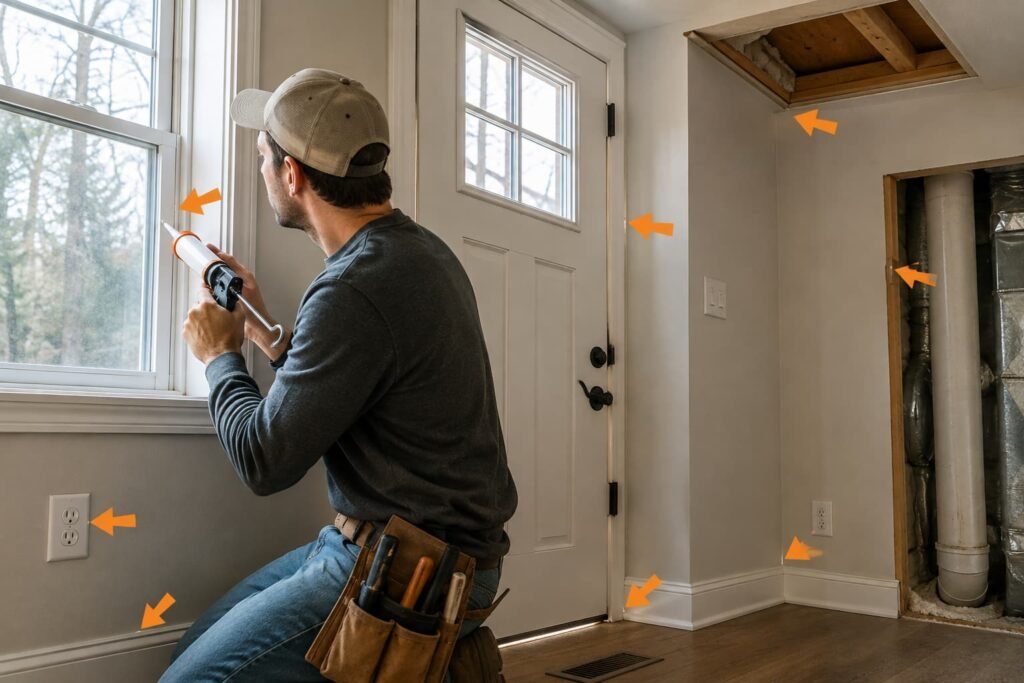
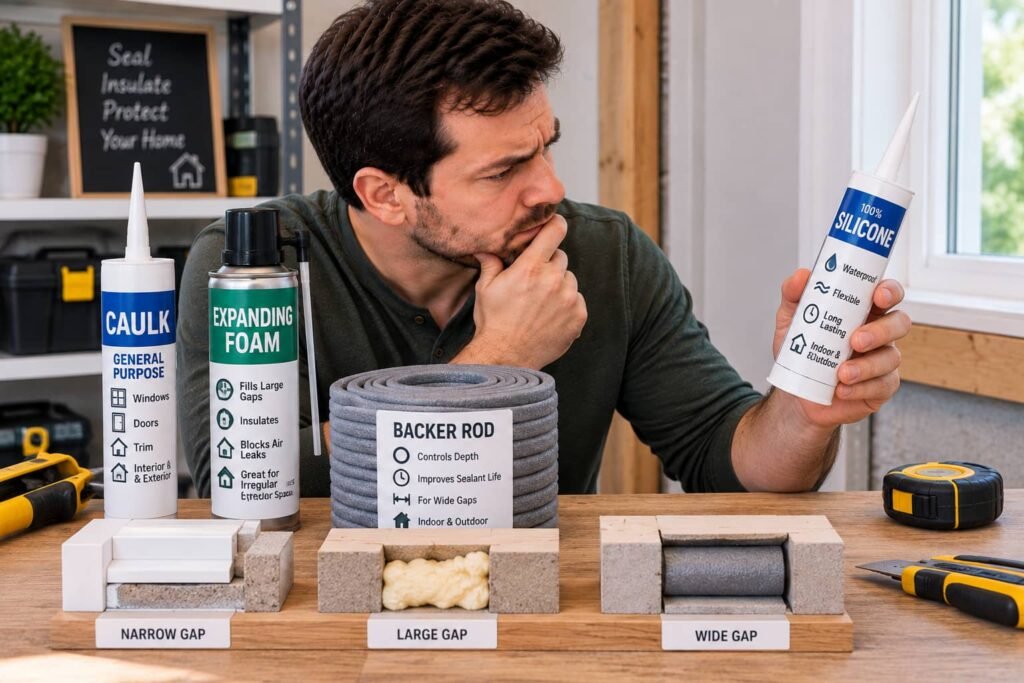
There is no single best caulk, and the shelf is confusing because the products are not competing with each other. They are answers to different gaps. ENERGY STAR's own attic guidance splits it by width: silicone or acrylic latex caulk for small holes of 1/4 inch or less, and expanding spray foam for larger gaps from 1/4 inch to about 3 inches. Anything wider than that is not a sealant job at all, it is a blocking job with a sealed edge.
We name no brands on this page and we have not tested any product. What follows is how to read a gap and then read a label, which is the part the roundups skip.
Start with the gap, not the aisle
Four questions decide the product, in this order.
How wide is it? Use the ENERGY STAR split above. Under 1/4 inch is caulk. From 1/4 inch to about 3 inches is single-component foam. Wider than 3 inches wants a rigid material cut to fit, foamed or caulked at the edges, because a bead of anything that thick shrinks, sags and cracks.
Will it move? A joint between two materials that expand at different rates in sun or frost is a moving joint. A hole where a wire passes through a top plate is not. Moving joints need a sealant rated for movement. Static holes do not.
What is it made of, and is it wet? Sealants are rated for specific substrates. Masonry, wood, painted metal and vinyl do not all take the same product, and a damp surface defeats most of them.
Where is it? Interior, exterior, in the ground, behind future drywall, or near heat. That last one has its own section below, and it overrides everything else on this page.
What the label is actually telling you
This is the criterion that replaces the word best. Many construction sealants are made to ASTM C920, the standard specification for elastomeric joint sealants, which classifies a product as Type, Grade, Class and Use.
Type S is single component, Type M is multi component. Grade NS is non-sag, meaning it stays where you gun it on a vertical joint, and Grade P is pourable or self-leveling for horizontal joints. The Class is the movement capability: a Class 25 product is rated to be compressed or extended by 25 percent of the original joint width, a Class 12.5 product to 12.5 percent, with higher classes such as 35, 50 and 100/50 handling more.
So the practical translation of "which caulk" is: for a joint that moves, find the class that covers the movement you expect and the Use designation that covers your substrates. For an interior hole in a top plate that will never move, the class is irrelevant and almost any interior-rated sealant will hold. Buying a high-movement exterior sealant for a static interior hole is spending money on a property you will not use.
The product classes, and what each one is for
| Class | Typical job in an air sealing project | What to check on the label |
|---|---|---|
| Acrylic latex, including siliconized versions | Small interior gaps and trim joints where the surface will be painted | Paintability, interior or exterior rating, substrate list, cleanup with water |
| Silicone | Small gaps at non-porous surfaces and wet areas | Whether it is paintable, which substrates it is rated for, whether it is a C920 product and its class |
| Polyurethane and hybrid construction sealants | Exterior moving joints, masonry to wood transitions | ASTM C920 class and Use designations, cure time, tooling window |
| Single-component polyurethane foam, straw or gun applied | Gaps 1/4 inch to about 3 inches, penetrations, framing gaps | Whether it is low expansion for windows and doors, its cure and cut times, and whether it carries a fireblocking listing |
| High temperature sealant | Only where the manufacturer states a temperature rating covering the location | The stated temperature rating, and read the flue section below first |
| Backer rod | The bottom of any joint deep enough to waste sealant | Open cell or closed cell, and the diameter relative to joint width |
Two notes worth more than the table. First, a gun-applied foam with a metal applicator gives far more control than a straw can, which matters when you are working overhead in an attic on a long list of penetrations, as in our guide to sealing top plates and penetrations from the attic. Second, low expansion foam exists for a reason: standard foam can bow a window or door jamb as it cures, so the window and door product is a genuinely different product rather than a marketing variant.
Backer rod, and why deep joints fail
Here is the part almost no homeowner air sealing article covers, and it is the difference between a joint that lasts and one that splits in a year.
A sealant joint is supposed to stretch. It can only stretch if it is bonded to two faces, the two sides of the joint, and free at the back. If the sealant also sticks to the back of the joint, it is bonded on three sides, has nowhere to go when the joint opens, and tears. Backer rod is the foam cylinder pushed into the joint to hold the sealant at the right depth and to stop that third bond. Where the joint is too shallow for rod, a polyethylene bond breaker tape across the back does the same job.
Depth matters too. Joint design guidance under ASTM C1193 sets a minimum joint of about 1/4 inch wide by 1/4 inch deep, keeps depth roughly equal to width up to about 1/2 inch wide, and then moves to a depth of about half the width for wider joints, with the depth capped at about 1/2 inch however wide the joint gets. In plain terms: a deep bead is not a strong bead, it is a wasteful one that is more likely to fail.
Backer rod comes in open cell and closed cell versions, and they behave differently in wet joints and with different sealants. Match the rod diameter to the joint so it compresses slightly rather than sliding in loose, and check the sealant manufacturer's own instructions, because some sealants specify a rod type.
The one place both caulk and foam are the wrong answer
Around a furnace flue or a chimney, stop and read this twice. ENERGY STAR's attic air sealing guidance states that building codes require 1 inch of clearance from metal flues and 2 inches from masonry chimneys to any combustible material, including insulation. It instructs that those gaps be sealed with lightweight aluminum flashing and special high temperature, heat resistant caulk, and it says plainly: do not use spray foam. The flashing forms a dam that keeps insulation away from the hot pipe.
That is a fire clearance requirement, not a preference, and ordinary sealants and foams are combustible. If you find a flue or chimney passing through the ceiling plane, the correct sequence is metal first, high temperature sealant second, insulation kept back third. If anything about the flue itself looks wrong, a disconnected joint, rust staining, a missing storm collar, that is a licensed HVAC technician's work and not a sealing job. We publish no procedure for anything touching a flue, a vent connector, a burner or a gas line, and code adoption varies by state and locality, so your building department has the final say.
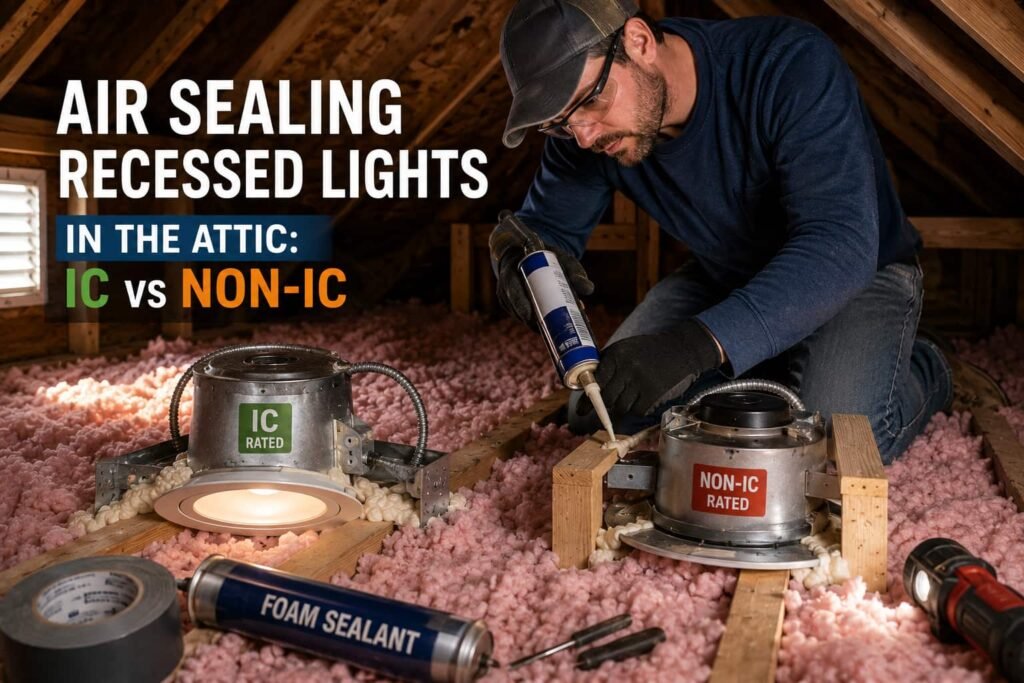
The same caution applies to recessed light housings, which have their own clearance rules and their own materials. That is covered separately in our page on air sealing recessed lights from the attic.
Where each one goes in a real house
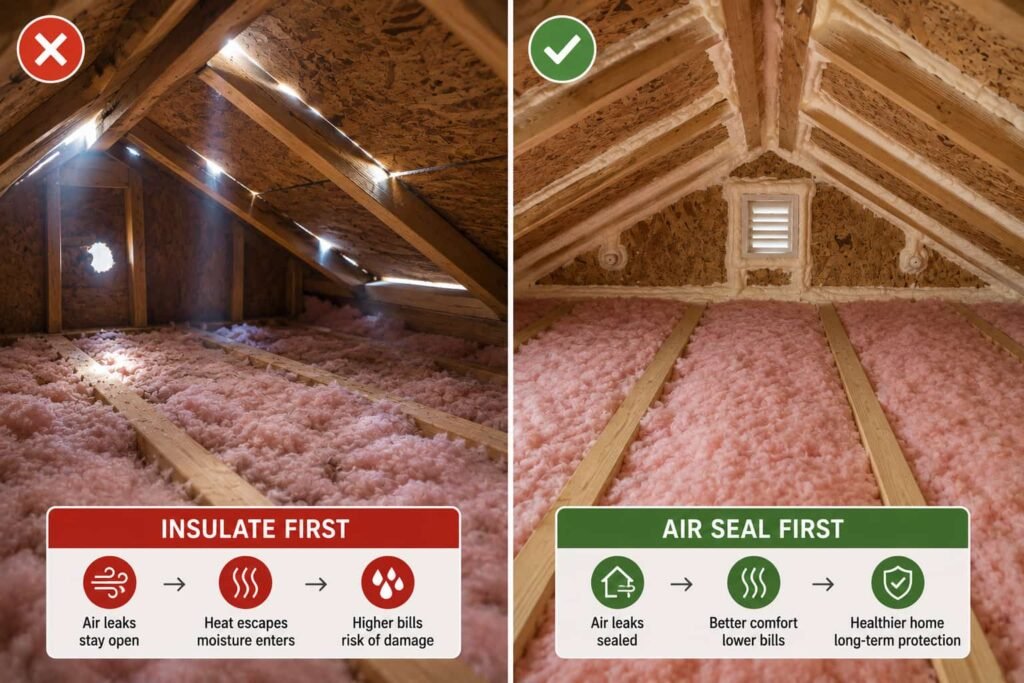
Working from the top down, which is the order set out in why air sealing comes before insulation:
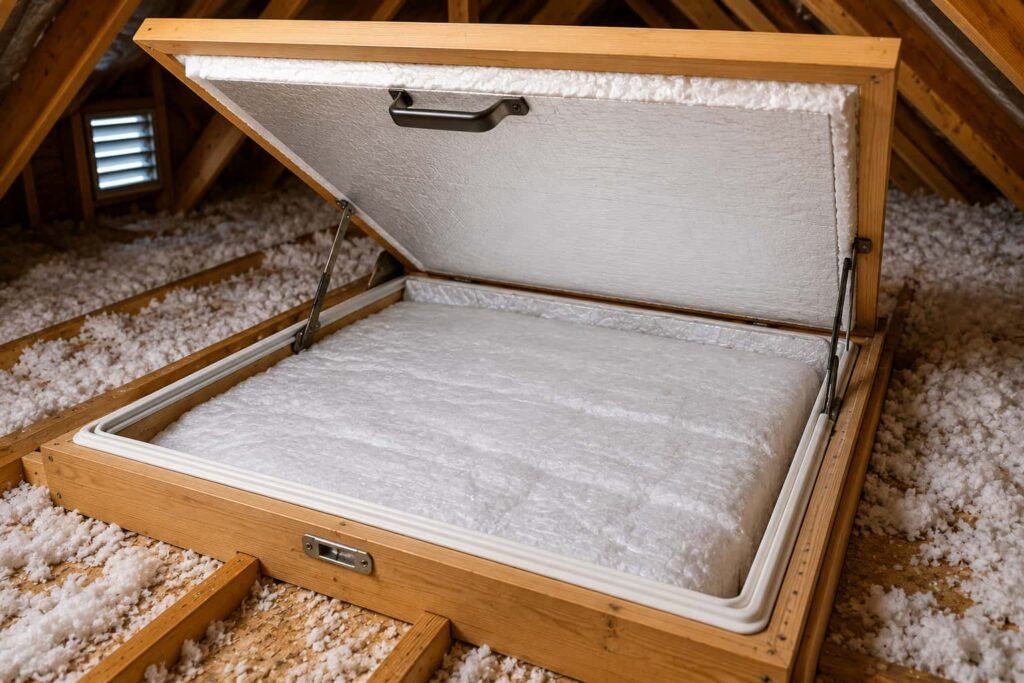
Attic plane. Wire and pipe penetrations through top plates are gun foam. The seam between the top plate and the drywall below is caulk. Around a flue is flashing and high temperature sealant. The attic hatch is not a sealant job at all, it is a gasket and weatherstrip job, covered in our page on the attic hatch.
Basement and crawl space. The sill plate to foundation seam is caulk if it is tight and foam if it is not. The rim joist edges around a foam board are gun foam. Larger penetrations for services are foam, and anything approaching 3 inches wants blocking first. That whole assembly is in our guide to insulating a rim joist by hand.
Living space. Gaps behind trim, at baseboards, and around window and door casings are small-gap caulk chosen for paintability. Exterior joints between different materials are where the ASTM C920 class actually earns its price.
What we will not tell you
We will not name a best caulk, publish a ranking, or print prices. Prices move, regional availability differs, and a product that is right for a moving exterior joint in a freeze-thaw climate is the wrong product for a static interior hole. The label, the manufacturer's technical data sheet and the substrate list are the specification. If a page tells you one tube is the answer to forty different gaps, it is selling, not specifying.
What we will say is that the most common mistake in this whole category is not choosing the wrong tube. It is sealing the wrong things: fifty feet of decorative trim joint in a living room while the top plates in the attic stay open. Find the leaks first, using the whole house leak map in where the leaks actually are, then come back to this page with a list of gaps and their widths.
Frequently asked questions
What is the difference between caulk and sealant?
In everyday use the words are interchangeable, and on a product shelf they mostly are. The useful distinction is movement capability. Products sold as sealants and made to ASTM C920 carry a stated movement class; general purpose fillers usually do not. If a joint moves, buy the one with the class on the label.
Can I use expanding foam around a window?
Use a product labeled as low expansion or specifically for windows and doors. Standard expanding foam can exert enough pressure as it cures to bow a jamb, which makes the window bind. Follow the foam manufacturer's instructions on gap size and on how full to fill the cavity.
Does the gap need cleaning first?
Yes, and this is where most failures begin. Sealants bond to the surface they touch, so dust, old flaking sealant, grease and loose paint all become the bond line. Remove the old material, clean the substrate as the label instructs, and let it dry.
How do I seal a gap wider than 3 inches?
Not with sealant. Cut a piece of rigid material to fit the opening, fix it in place, then foam or caulk the perimeter. That is the same logic used at open joist bays and large penetrations, and it uses far less product than trying to bridge the span with foam.
Is fire block foam the same as ordinary foam?
No. Some foams carry listings for use in fireblocking applications and are usually colored to be identifiable. Whether a specific product may be used in a fireblocking or firestop application is stated in its own listing and evaluation report, and your inspector decides whether it satisfies the code in force where you live. Do not assume an ordinary foam qualifies because it is the same color, and do not use any foam where ENERGY STAR's flue guidance above applies.
Sources
- ENERGY STAR, "Attic Air Sealing Project" (energystar.gov): silicone or acrylic latex caulk and a caulk gun for sealing small holes of 1/4 inch or less; several cans of expanding spray foam insulation for filling larger gaps from 1/4 inch to 3 inches; building codes requiring 1 inch of clearance from metal flues and 2 inches from masonry chimneys to any combustible material including insulation; sealing those gaps with lightweight aluminum flashing and special high temperature, heat resistant caulk; a metal dam of aluminum flashing before insulation is replaced; and the instruction not to use spray foam at a furnace flue. Accessed 2026-09-07.
- ENERGY STAR do-it-yourself guide, attic and basement sealing pages: use expanding foam or caulk to seal openings around plumbing vent pipes and electrical wires, and seal penetrations through the basement ceiling to the floor above including wires, water supply and drain pipes, the plumbing vent stack and the furnace flue. Accessed 2026-09-07.
- ASTM C920, Standard Specification for Elastomeric Joint Sealants: the Type, Grade, Class and Use classification, with Type S single component and Type M multi component, Grade NS non-sag and Grade P pourable, and movement classes including 12.5, 25, 35, 50 and 100/50 expressed as a percentage of the original joint width. Standard summarized from published descriptions of the specification, accessed 2026-09-07.
- ASTM C1193, Standard Guide for Use of Joint Sealants, joint design principles as summarized by sealant manufacturers: minimum joint of about 1/4 inch by 1/4 inch, depth approximately equal to width up to about 1/2 inch wide, depth about half the width for wider joints, depth capped at about 1/2 inch, and the use of backer rod or bond breaker tape to prevent three-sided adhesion. Accessed 2026-09-07.
Building code requirements vary by state and locality. Clearance and fireblocking requirements are set by the code in force where you live, and your local building department or inspector governs what applies to your house. Always follow the instructions on the product you buy; they override any general guidance here.