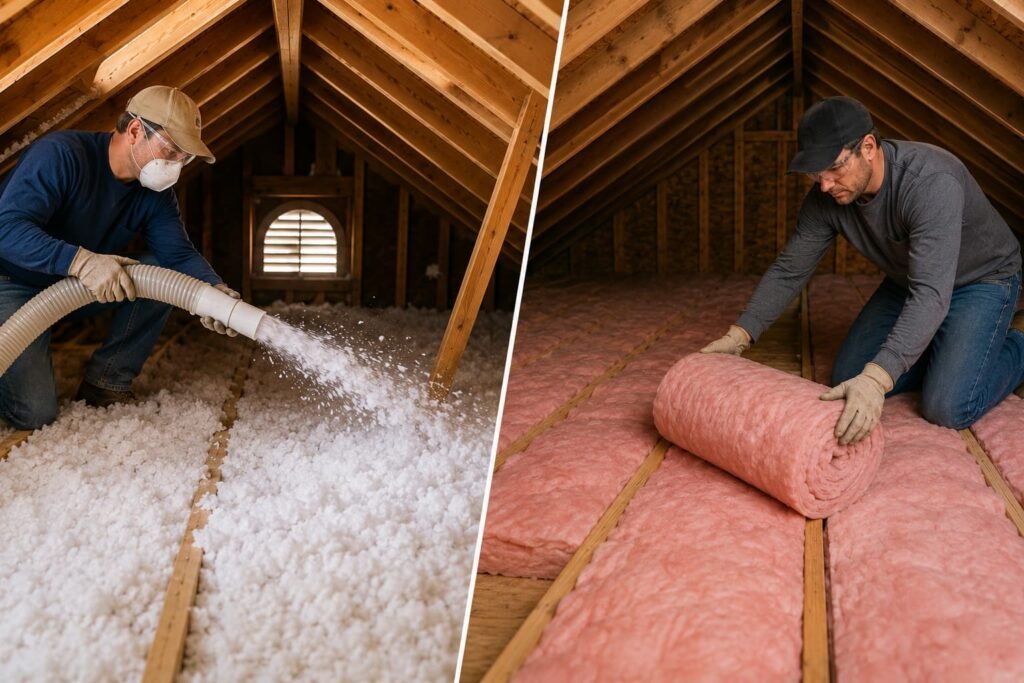
The blown in vs batt insulation decision is settled by the shape of your attic, not by the material. Loose fill blown from a hose is what the US Department of Energy describes as well suited to irregularly shaped areas, around obstructions such as plumbing stacks, and in hard to reach places. Batts are cut rectangles, so they perform where the framing is regular, open and reachable. If your attic floor is a clean grid of evenly spaced joists you can reach on both knees, batts are workable. If it is not, loose fill will end up better installed.
That last clause is the part the comparison pages skip. Both materials publish an R-value; neither delivers it if the installation is poor, and the two materials fail in different ways.
What each one actually is
Blanket insulation, meaning batts and rolls, is the most common and widely available type, supplied in widths sized to standard joist and stud spacing. It arrives compressed, it is cut with a knife, and it is placed by hand.
Loose fill is fiberglass, cellulose or mineral wool in shredded form, fed into a machine that blows it through a hose. It fills what it lands in. Because it is blown, the Department of Energy notes it works in spaces that are irregular in shape and size, and in areas with low ceilings or obstacles that make moving around difficult, which describes most retrofit attics honestly.
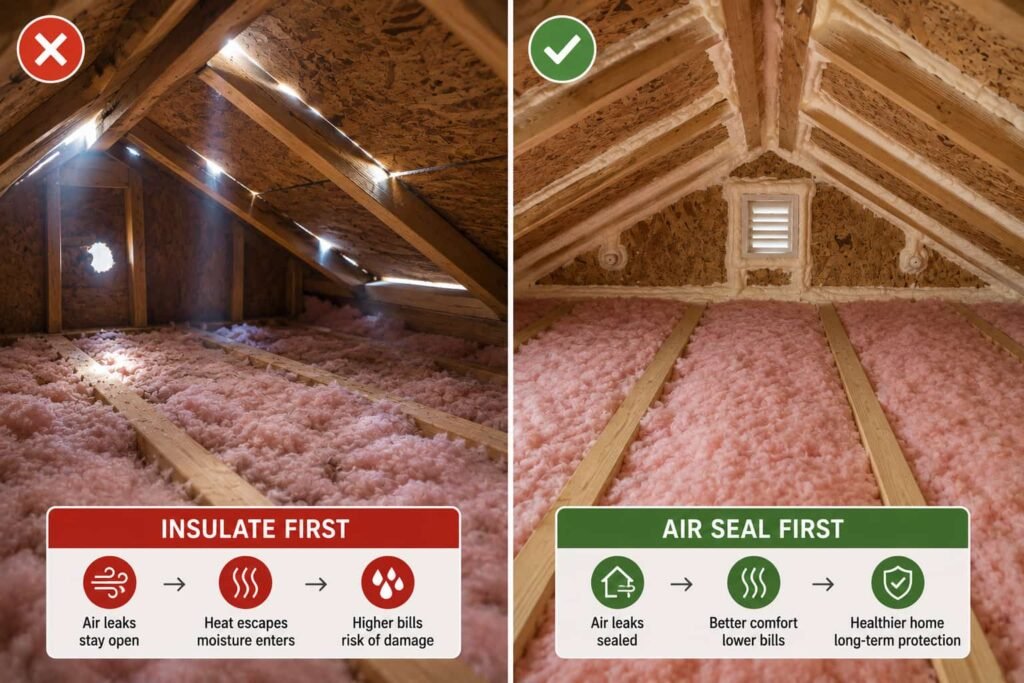
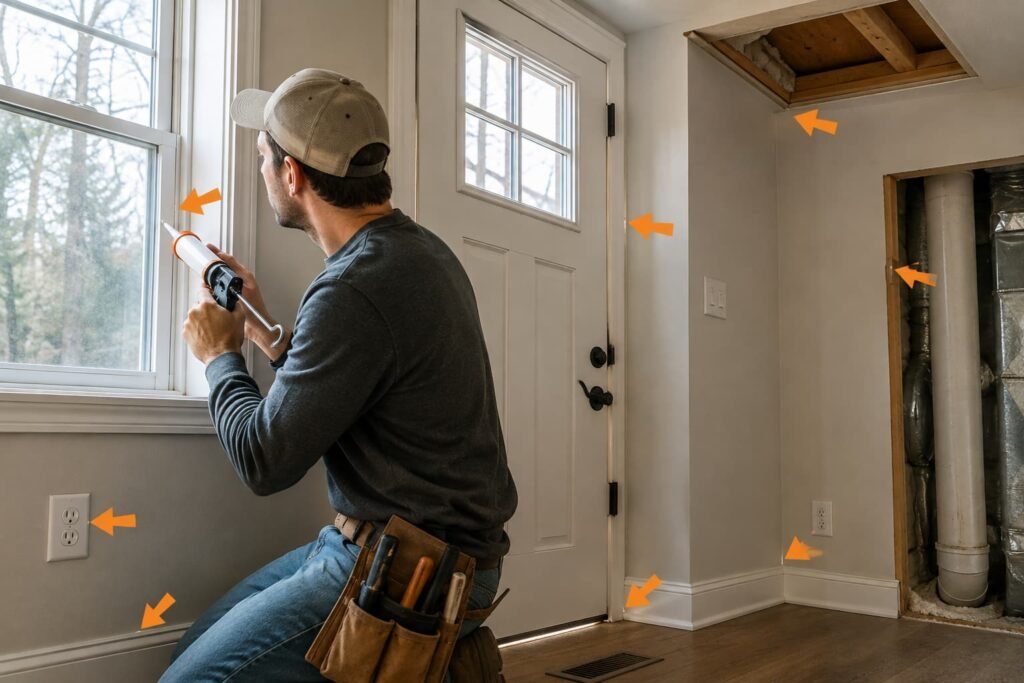
Neither is an air barrier. Fibrous insulation is air permeable by design, which is why the order of the work puts sealing first and why laying either material over open top plates and chases converts it into a filter.
The decision table
| What your attic looks like | Which material fits | Why |
|---|---|---|
| Even joist spacing, clear span, no obstructions | Batts | Cut to width, fit tight, verify by eye |
| Irregular or non-standard joist spacing | Loose fill | Fitted batts leave gaps that are hard to close |
| Cross bracing, ducts, wiring, plumbing stacks in the way | Loose fill | It flows around obstructions; batts have to be cut around each one |
| Low headroom at the eaves and along the perimeter | Loose fill | You can reach the edge with a hose you cannot reach with your arms |
| Existing loose fill already in place | Loose fill on top | Adding depth without disturbing what is there |
| You need a defined edge, such as at a dam or a knee wall | Batts or rigid blocking | Loose fill needs something to hold it back |
| No power at the attic access, or no help available | Batts | The machine needs a second person and an outlet |
Nobody's attic matches one row exactly. Where they conflict, weigh the obstruction row heaviest, because that is where batt installations lose the most.
The number that decides the purchase is on the bag
This is the part worth knowing before you compare products at all. Under the Federal Trade Commission's R-value Rule, codified at 16 CFR Part 460, loose fill packages have to carry a chart showing, for R-values of 13, 19, 22, 30, 38 and 49, the minimum settled thickness, the initial installed thickness, the maximum net coverage area, the number of bags per 1,000 square feet, and the minimum weight per square foot. Loose fill labels also have to state the blowing machine and settings used to derive the initial installed thickness.
So the honest way to plan a loose fill job is to read the chart for the R-value you are targeting and count bags from it. Coverage per bag is the operative number, not R per inch, and it is different for every product because the density differs. Any web page, including this one, that prints a bag count for your attic is guessing. The bag is a regulated disclosure; the blog is not.
Installation quality is the real variable
Both materials are rated in a lab and installed in an attic. The standard used by home energy raters, ANSI/RESNET/ICC 301, grades installed insulation and models the difference: a Grade III installation is modeled as having no insulation R-value across 5 percent of the insulated surface area, and Grade II across 2 percent. That is the published way of saying gaps cost you real performance, and it is a fairer statement than the unsourced percentages contractor pages print.
The Department of Energy's own installer checklist puts the same requirement in plain words: ensure that insulation has no gaps, voids, compression or misalignment. Batts fail by gap, at cross braces, around wiring and where a piece was cut a little short. Loose fill fails by depth, thin at the perimeter and near the hatch, which is why the depth marker requirement exists at all. Each material forgives the mistake the other punishes.
Before either bag or hose goes up there
Combustion safety comes before insulation work. Tightening a house changes the pressure an atmospherically vented furnace, boiler or water heater drafts against, and the Department of Energy's Energy Saver guidance describes how a reversed draft can bring combustion gases, including carbon monoxide, indoors. Working carbon monoxide alarms installed to the alarm manufacturer's instructions are the floor, and a combustion safety test by a licensed HVAC technician, a licensed gas fitter or a certified energy auditor is the decision. No article on this site prints a step for a gas line, a flue, a vent connector or a burner.
In the attic itself: loose fill hides the joists and there is no floor between them, the space gets very hot, and flues can be hot enough to burn. The Insulation Institute, the health and safety program of the North American Insulation Manufacturers Association, recommends loose fitting long sleeved and long legged clothing, gloves, eye protection whenever the material is handled, and a NIOSH certified N95 dust respirator where exposure warrants it. Knob and tube wiring stops the job until a licensed electrician has been, and vermiculite, a light gray, pea sized, flaky mineral, stops it too, because the EPA advises leaving it undisturbed as it may contain asbestos.
Putting one over the other
You can add batts over loose fill or loose fill over batts, with two conditions the Department of Energy states. Higher density material should generally not go on top of lower density insulation that compresses easily, because compressing the layer underneath lowers its R-value. And a vapor retarder buried in the middle of an assembly can trap moisture, so unfaced material is the usual choice when topping up.
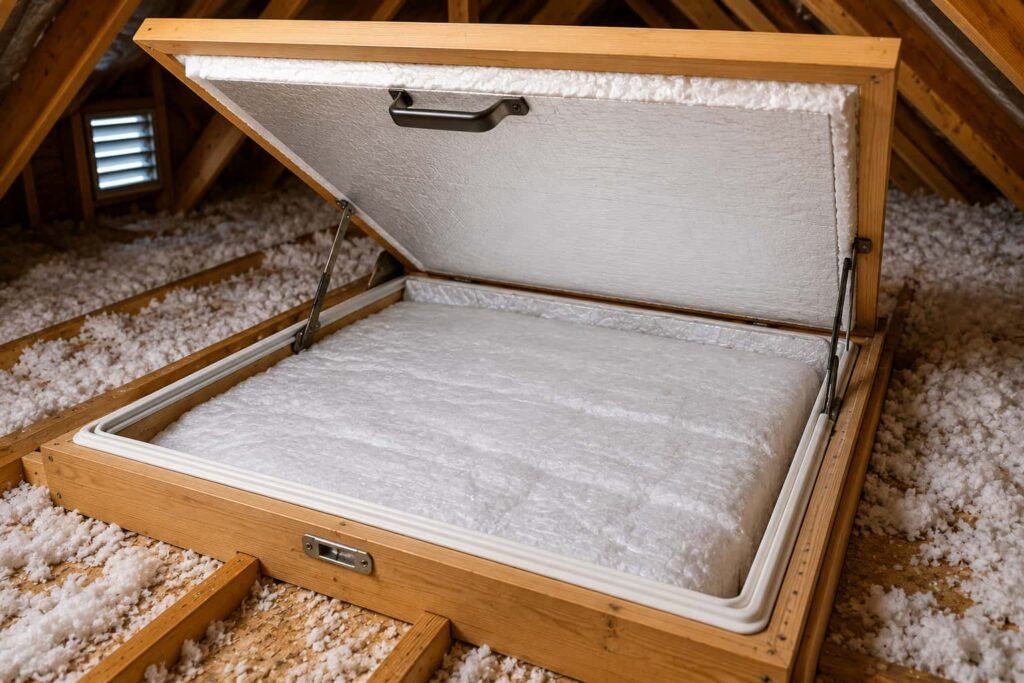
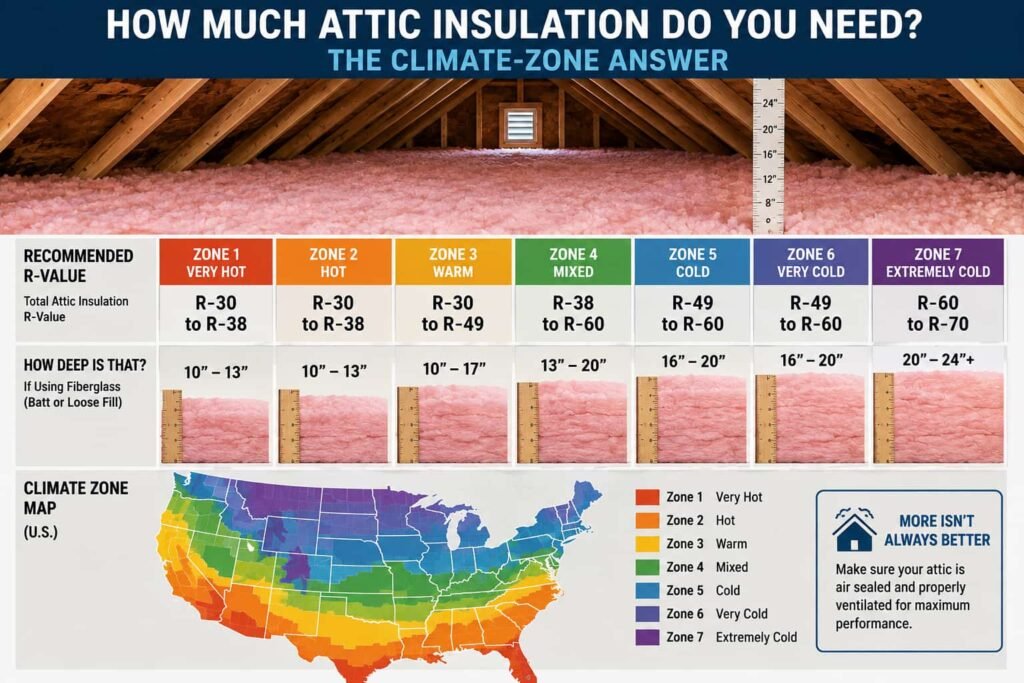
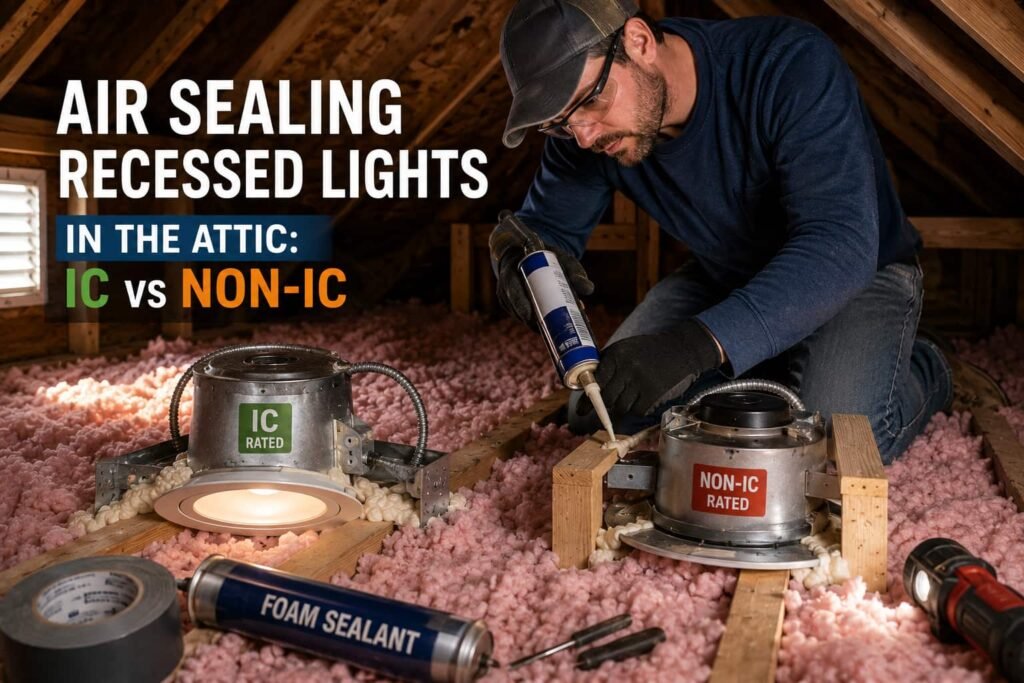
Two other conditions are yours to check first. Whatever is already there has to be dry, not matted, not rodent fouled, and not vermiculite. And the fixed obstacles have to be handled before depth goes on: baffles holding the ventilation path open at the eaves, a dam around the hatch, and enclosures or clearances around any recessed light that is not rated for insulation contact. What depth to aim for at all is a climate zone question, answered in our guide to how much attic insulation you need.
What this page will not tell you
It will not tell you which is cheaper for your house, because material price, bag count, machine access and whether you already own a utility knife are all local. It will not print a savings percentage for either material, because no public source separates the saving from one measure out of a job that also involves sealing. And it will not claim we have installed either one, because we have not: this page is assembled from federal program documents, a federal labeling rule and a rating standard, all named at the end.
What it will say is that the material you can install well in your particular attic beats the material with the better datasheet. The leak map behind the whole project is the thing to finish before this choice matters at all.
Frequently asked questions
Is blown-in insulation better than batts?
Neither is better in general. Loose fill covers irregular framing and obstructions that batts have to be cut around, which is why the Department of Energy points it at hard to reach places. Batts give a defined edge and need no machine. The better material is the one your attic lets you install without gaps, voids or compression.
Can I install batts over existing blown-in insulation?
Usually yes, using unfaced batts, and laid across the joists rather than only between them. Watch the density rule: the Department of Energy cautions against placing a higher density material on top of a lower density one that compresses easily, because that reduces the thickness and the R-value of the layer underneath.
How many bags of loose fill will I need?
Read the coverage chart on the bag of the product you are buying. Under the FTC R-value Rule it has to show the maximum net coverage area and the number of bags per 1,000 square feet at your target R-value, along with the initial installed thickness. That chart describes the product in your hands; a general figure from a web page does not.
Does cellulose settle more than fiberglass?
Settling is exactly why loose fill labels carry both a minimum settled thickness and an initial installed thickness under the same FTC rule. Compare those two lines on the two products you are considering rather than trusting a general claim about the material category. The difference between them is what tells you how much extra depth to install on day one.
Sources
- US Department of Energy, Energy Saver, "Types of Insulation" (blanket batts and rolls; loose fill suited to irregularly shaped areas, obstructions and hard to reach places; guidance on layering materials of different density and on facings), accessed 2026-08-24.
- Federal Trade Commission, R-value Rule, 16 CFR Part 460, labeling requirements for loose fill home insulation, including minimum settled thickness, initial installed thickness, maximum net coverage area, bags per 1,000 square feet and minimum weight per square foot at R-13, 19, 22, 30, 38 and 49, checked 2026-08-24.
- ANSI/RESNET/ICC 301, insulation installation grading, Grade II modeled at 2 percent and Grade III at 5 percent of the insulated surface area with no insulation R-value, checked 2026-08-24.
- US Department of Energy, State and Community Energy Programs, Weatherization Installer Job Aid 8-5, DOE/GO-102023-5934, June 2024, for the installation checklist wording on gaps, voids, compression and misalignment, read 2026-08-24.
- Insulation Institute (North American Insulation Manufacturers Association) health and safety guidance, read 2026-08-24.
- US Department of Energy, Energy Saver guidance on backdrafting and combustion safety, and US Environmental Protection Agency guidance on vermiculite insulation, accessed 2026-08-24.
Building code requirements vary by state and locality, and product coverage figures vary by product. Where this page names a figure it is quoting a federal rule, a federal program or a national standard, and the label on the bag governs the material you actually buy.