Short answer: In the storm windows vs replacement windows decision, the deciding factor is the window you already have. If the existing sash and frame are sound, a storm window or interior insert adds a second layer of glass for much less money, and ENERGY STAR says certified storms cost one half to one quarter as much as common replacement windows. If the frame is rotted, the sash will not work, or most parts need replacing, replace the window.
That is the rule. The rest of this page is how to tell which side of it your windows are on, and what to check before you buy either one.
What each option actually is
A storm window is a second window mounted over the one you have. ENERGY STAR's storm windows page, which we read on 2026-09-25, describes them as "installed as attachments to existing primary windows." They come in two families:
- Exterior storms mount on the outside of the existing frame.
- Interior storms and inserts fit inside the frame, on the room side. Many press in or attach magnetically and come out for summer or cleaning.
A replacement window removes the old sash, and sometimes the whole frame, and puts a new unit in the opening. It usually has two or three panes of glass sealed together at the factory.
Both leave you with at least two layers of glass. The difference is what happens to the window that is already there. A storm keeps it and protects it. A replacement throws it away.
The one question that decides it
ENERGY STAR puts it in one line: "Storm windows work best when installed over working primary windows that are in good condition."
So before comparing prices or brands, walk every window and answer four things.
- Is the frame solid? Push a screwdriver tip into the sill and the bottom of the frame. Wood that is soft and gives is rot.
- Does the sash open, close and lock? A sash that sticks shut or will not close fully is a problem a storm cannot fix.
- Is the glass intact? A cracked pane is a hole. Replace the glass either way.
- How many parts would a repair need? A few loose pieces is a repair. Most of the window is a replacement.
The National Park Service, writing about historic buildings, draws the line at that last point. Its weatherization guidance, which we read on 2026-09-25 (last updated April 11, 2022), says that if most of the work is minor repair, "the windows should be repaired. But, if a large number of new parts are required, then it may be appropriate to consider investing in a good, matching replacement window."
Storm windows vs replacement windows, side by side
Here is how the two compare on the things a homeowner actually weighs. We have left prices out; they vary too much by size, count and region to be useful, and the one cost comparison we trust is ENERGY STAR's, quoted below.
| Question | Storm window or insert | Replacement window |
|---|---|---|
| Keeps the original window? | Yes | No |
| Needs a sound existing window? | Yes | No |
| Adds a second layer of glass? | Yes | Yes, built in |
| Fixes a rotted frame or broken sash? | No | Yes |
| Changes the look from the street? | Exterior: somewhat. Interior: no | Often |
| DIY-friendly? | Many models, per ENERGY STAR | Usually a contractor job |
| Relative cost | One half to one quarter of common replacements, per ENERGY STAR | Higher |
| Reversible? | Mostly | No |
The cost row comes from ENERGY STAR's page comparing high performing windows and storm windows, read on 2026-09-25. It says certified storm windows "cost ½ to ¼ the amount of common replacement windows with much lower cost installation," and that they "can also be Do-It-Yourself installed without training."
How close does a storm window get?
This is the question window sales pages skip.
The National Park Service's weatherization guidance cites a study: "A 2002 study confirmed that installing a storm window over a historic window can achieve a similar thermal performance to that of a new low-E vinyl replacement window." In other words, a sound old window with a good storm over it can behave like a two-layer window, because that is what it has become.
The same NPS page adds a point worth knowing: "Remaining air infiltration around the historic window and storm assembly is a matter of occupant comfort rather than energy efficiency." A little air movement you can feel at the old sash is not necessarily costing you much. That changes what you are buying a storm for.
ENERGY STAR also publishes its own national-average savings estimate for certified low-e storm windows installed over single-pane clear glass. We do not repeat it here. Read it on the ENERGY STAR page itself, next to the assumptions it depends on, because your house is not the national average.
Exterior or interior: which storm fits
If a storm is the right call, the next choice is which side.
Exterior storms also shield the old sash and putty from rain and sun, which helps an old wood window last. The drawback is appearance. The NPS notes that "adding exterior storm windows to highly decorative or multi-light windows may conceal important details. In these situations, interior storm windows may be preferable."
Interior storms and inserts leave the outside of the house unchanged, which suits decorative windows, upper floors that are hard to reach from outside, and long-term renters who cannot alter the exterior. The watch-out is moisture. If warm, humid room air slips past an interior storm, it can condense on the cold original glass behind it. An interior storm should seal snugly to the frame on the room side.
What to check before you buy a storm or insert
This site does not rank or recommend storm window brands. We have not tested any. What we can give you is the checklist to hold any product against:
- ENERGY STAR certified, and for your zone. ENERGY STAR's storm window specification has been in effect since September 5, 2018, and certified storms use low-e glass. Product labels show which part of the country they are designed for.
- Weep holes on exterior storms. ENERGY STAR excludes "exterior storm windows without weep holes or other features that allow moisture to drain from between the storm window and primary window." Water that gets in needs a way out. Never caulk the weep holes shut.
- Operable or fixed. ENERGY STAR notes both types exist. In a bedroom, where a window may be the emergency way out, a fixed storm over the only window is the wrong product. Your local building department can tell you what applies to escape windows in your area.
- Existing tinted glass. ENERGY STAR cautions that a low-e storm over tinted glass "may reduce the visible light transmitted through the window, making them even darker."
- Very hot climates. ENERGY STAR also warns that "in very hot climates and under certain conditions, low-e storm windows can trap heat between the original window and the storm window."
- Custom fit. Old openings are rarely square. ENERGY STAR notes storms can be "specialty manufactured to perfectly fit to your current windows."
When replacement is the better answer
We are not against new windows. Replacement wins when:
- The frame itself is rotted, not just the paint.
- The sash cannot be repaired without remaking most of it.
- The window cannot be opened, and the room needs it as an escape route.
- The wall is already open for siding, structural or other work.
- The existing unit is a failed modern window you would not keep anyway.
If you land here, compare replacement units on their NFRC label, especially U-factor and solar heat gain for your climate zone, and read the quote to see exactly what is being removed and what stays.
If you are looking at a weatherization or efficiency program to help pay for either option, confirm the current details on the U.S. Department of Energy's live program page first. Program rules change, and we do not repeat them here.
Before either one: the bigger holes
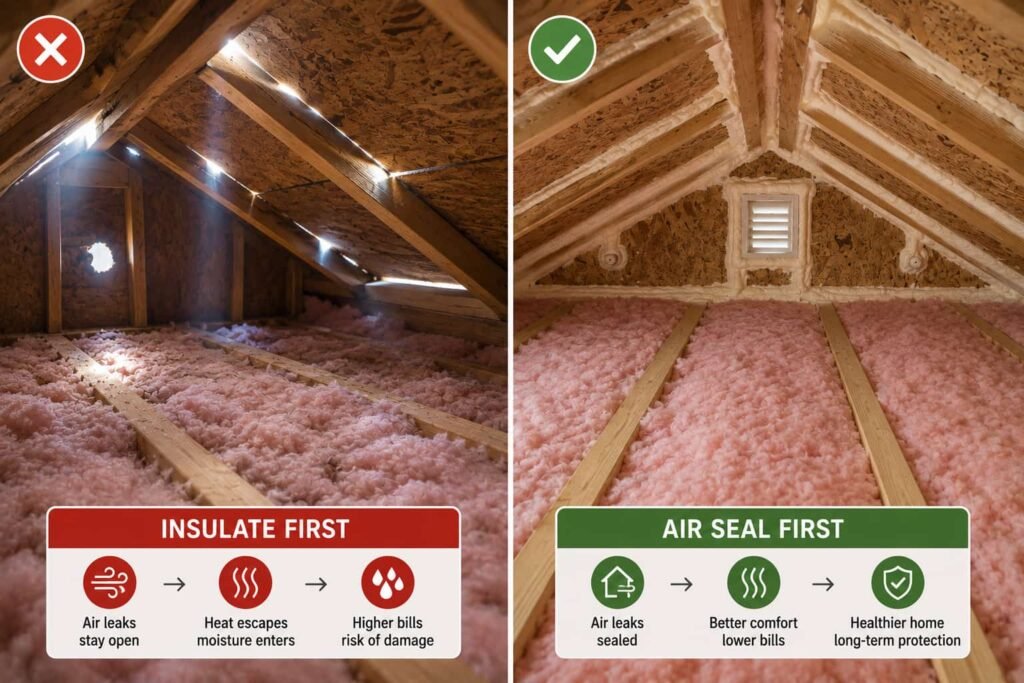
Windows are the part of the house you can see, so they get blamed first. In most houses, the bigger air leaks are in the attic floor and around the basement rim, where warm air escapes at the top and cold air is pulled in low.
A DIY home energy audit will show you whether the windows are really where your heat goes. A smoke pencil test for air leaks will show you whether the drafts you feel start at the sash or somewhere behind the trim. And if you want a whole-house number before you spend on glass, a blower door test tells you how leaky the house is overall. We explain why sealing comes first in air seal before you insulate.
Lead paint in older windows
If the house was built before 1978, treat the window paint and putty as possibly containing lead until a test says otherwise. Installing storms or replacements can scrape or cut painted surfaces.
The U.S. EPA's Renovation, Repair and Painting Rule, read on 2026-09-25, requires that "anyone paid to perform work that disturbs painted surfaces in homes, childcare facilities and preschools built before 1978 be certified." It does not apply to homeowners working on their own home, unless they rent it out, run a childcare center there, or renovate homes to sell. EPA recommends do-it-yourself lead-safe work practices either way. If you hire an installer, ask to see the certification.
What we can't tell you
We cannot tell you how much either option will save in your house. That depends on your climate, fuel, window count, orientation and how leaky the rest of the house is, and no public source gives that figure for a single home. We can tell you the order: find the losses, seal the big holes, then decide window by window whether the existing unit is worth keeping.
Frequently asked questions
Are storm windows as good as replacement windows?
Over a sound window, they can come close. The National Park Service cites a 2002 study finding that a storm window over a historic window can achieve thermal performance similar to a new low-E vinyl replacement. Over a rotted or broken window, a storm is the wrong fix.
Are storm windows cheaper than replacement windows?
Yes, usually by a wide margin. ENERGY STAR says certified storm windows cost one half to one quarter as much as common replacement windows, with much lower installation cost.
Can I install storm windows myself?
Many can be. ENERGY STAR says certified storm windows "can also be Do-It-Yourself installed without training." Work above a first-floor window from a ladder is a different matter; hire it out if you are not comfortable at height.
Should I choose an interior or exterior storm window?
Exterior storms protect the old sash from weather. Interior storms keep the outside unchanged and suit decorative windows and renters. The NPS suggests interior storms where exterior ones would hide important details.
Do storm windows cause condensation?
They can. Interior storms that let humid room air reach the cold original glass can cause condensation on the old sash. A snug seal on the room side helps. Exterior storms need weep holes so moisture between the layers can drain.