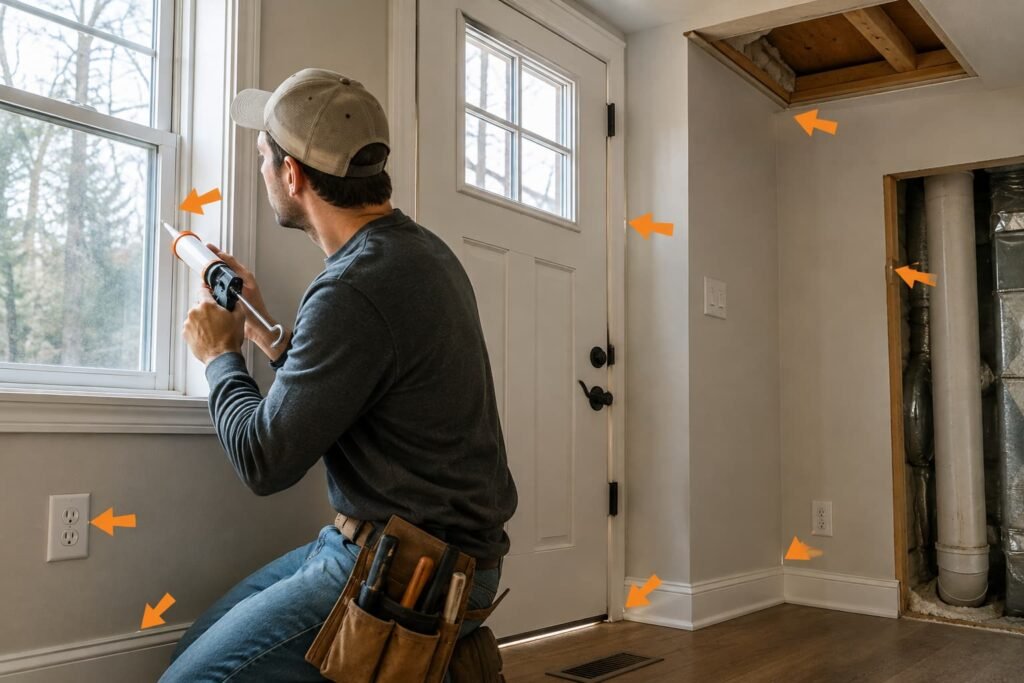
Stack effect house air leaks happen because warm air inside your home rises and escapes through gaps near the roofline, and that escaping air pulls cold outside air in through cracks near the floor, foundation, and lower walls to replace it. The taller the house and the colder it is outside, the stronger this pull becomes. That is why your feet are cold even when the thermostat reads 70, and why sealing the attic first, not the windows, is usually what fixes it.

What Causes Stack Effect House Air Leaks
Warm air is lighter than cold air, so it rises inside a heated house the same way it rises in a chimney. As it collects near the ceiling and attic, it pushes out through every gap it can find: attic hatches, recessed lights, plumbing stacks, wiring holes, and gaps around the chimney chase. Every cubic foot of air that leaves at the top has to be replaced by a cubic foot coming in somewhere else, and physics pulls that replacement air in at the lowest point available: rim joists, sill plates, basement windows, and foundation cracks. The Department of Energy's Building Science Education Series describes the same mechanism from the top down, noting that sealing holes in the attic ceiling reduces the house's "suction," which is the stack effect, and that this also cuts down on soil gases like radon being drawn up from the ground (DOE Building Science Education Series, accessed 2026-09-18).
Why Height and Cold Weather Make It Worse
Stack effect scales with two things: how tall the house is and how big the temperature difference is between inside and outside. A two-story house with a walk-up attic has more vertical distance for warm air to climb than a single-story ranch, so the pull at the bottom is stronger. A split-level with a knee wall attic on one side often shows the same problem in just that one room, because the attic space behind the knee wall acts like its own short chimney. Cold snaps make it worse for the same reason: the bigger the gap between your 70-degree living room and 20-degree air outside, the harder the warm air pushes to get out and the harder the cold air gets pulled in behind it. A leaky attic paired with a leaky basement is the combination that produces the strongest pull of all, because both ends of the "chimney" are open at once.
Signs It Is Stack Effect, Not Just Old Windows
Homeowners often blame the nearest window, but a few patterns point specifically at stack effect instead:
- Upstairs rooms feel warm or stuffy while the basement or first floor feels cold, even with the thermostat set the same everywhere.
- Doors on upper floors are harder to close, or whistle, because of the pressure difference pushing against them.
- Cold air seems to come from baseboards, electrical outlets, or the bottom of interior walls, not just from windows and exterior doors.
- The problem gets noticeably worse on the coldest nights of the year and eases up on mild days, tracking temperature rather than wind.
- A lit candle or incense stick held near an attic hatch or a basement rim joist visibly bends toward or away from the gap, showing air actually moving through it.
If several of these match your house, the leaks doing the damage are more likely at the top and bottom of the building than at the window sashes.
It Runs in Reverse in Summer
When the air conditioning is on and it is hot outside, the pressure relationship flips. Cool, denser air near the floor tends to settle and leak out at the bottom of the house, and hot outside air gets drawn in through gaps near the top, particularly through a hot attic pressing down on ceiling penetrations. The effect is usually weaker in summer because the indoor-outdoor temperature difference is smaller than a cold winter night, but the same leak points are doing the work in both seasons. That is one more reason sealing a leak point pays off year round rather than only in heating season.
Where the Air Actually Gets In and Out
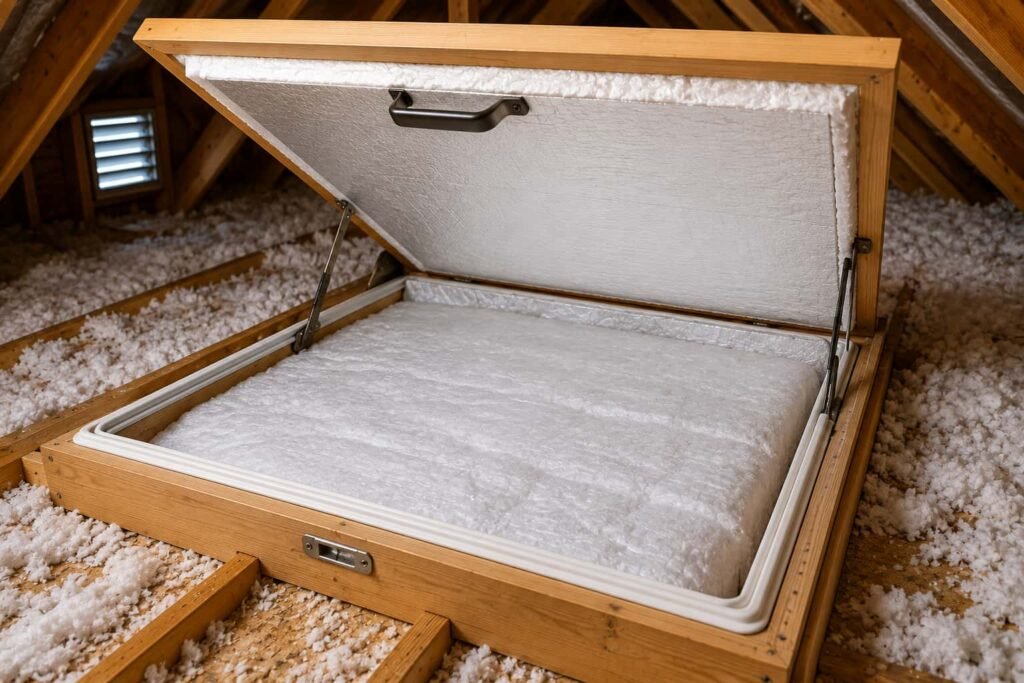
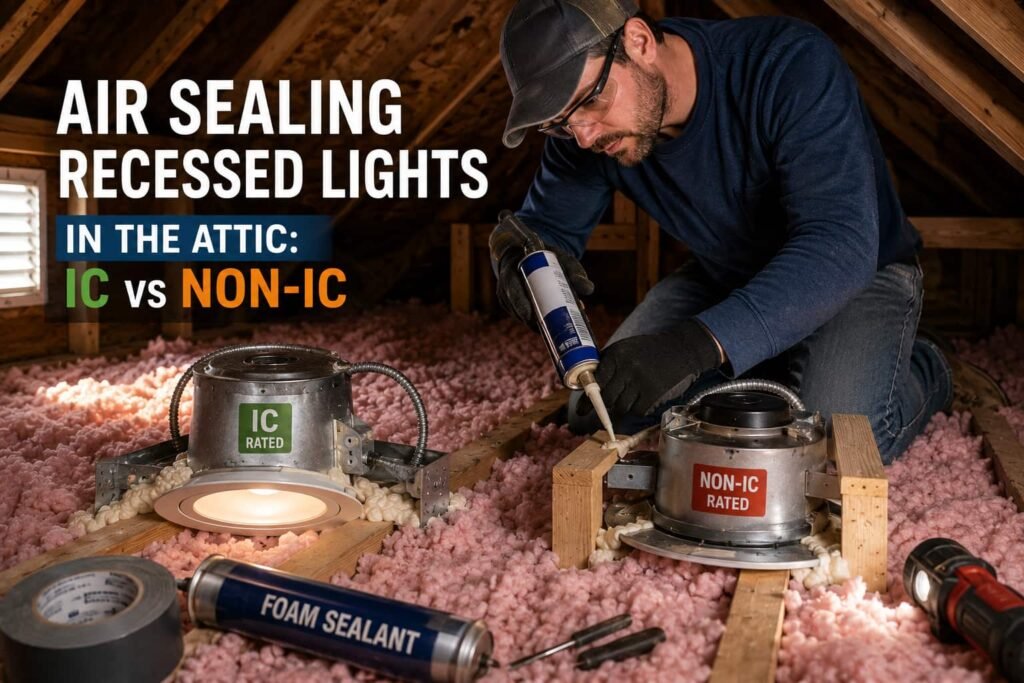
Top-of-house leaks cluster around anything that penetrates the ceiling into the attic: recessed can lights, the attic access hatch, bathroom and kitchen exhaust duct chases, plumbing vent stacks, and the top plates where interior walls meet the attic floor. A DIY home energy audit walks through spotting these without special tools, and once you have a list, sealing the attic top plates and penetrations is usually the single highest-value fix because it is closest to where the pressure is strongest. Bottom-of-house leaks show up at the rim joist (where the floor framing sits on the foundation), sill plates, basement or crawlspace penetrations, and old dryer vent or hose bib holes. Because that framing cavity runs the full perimeter of the house, insulating and air sealing the rim joist closes a surprising share of the cold-air complaints that get blamed on windows.
What Stack Effect Costs You
Air leakage is not just a comfort problem. ENERGY STAR states that homeowners can save an average of 15% on heating and cooling costs, and about 11% on total energy costs, by air sealing their homes and adding insulation in attics, floors over crawl spaces, and basements (ENERGY STAR, "Why Seal and Insulate?", accessed 2026-09-18). That figure covers the whole envelope, not stack effect alone, and your own numbers depend on your climate zone, house height, and how leaky the house already is. Treat it as a planning range, not a guarantee for your specific address.
Find the Leaks Before You Chase Them One at a Time
The instinct is to walk around with a hand on every window and door looking for drafts. That finds the leaks you can feel, not the ones doing the most work. A blower door test depressurizes the whole house and reveals, with a number attached, how much air is actually moving through the envelope and roughly where. That number matters because stack effect leaks concentrate at the top and bottom of the house, in places most homeowners never check: above the insulation in the attic, and down inside the rim joist cavity behind the basement ceiling. Chasing visible drafts at eye level first usually means fixing the smallest leaks last, and it gives no way to confirm afterward whether the work actually made a difference.
Seal Top and Bottom, Not Wherever Feels Windy
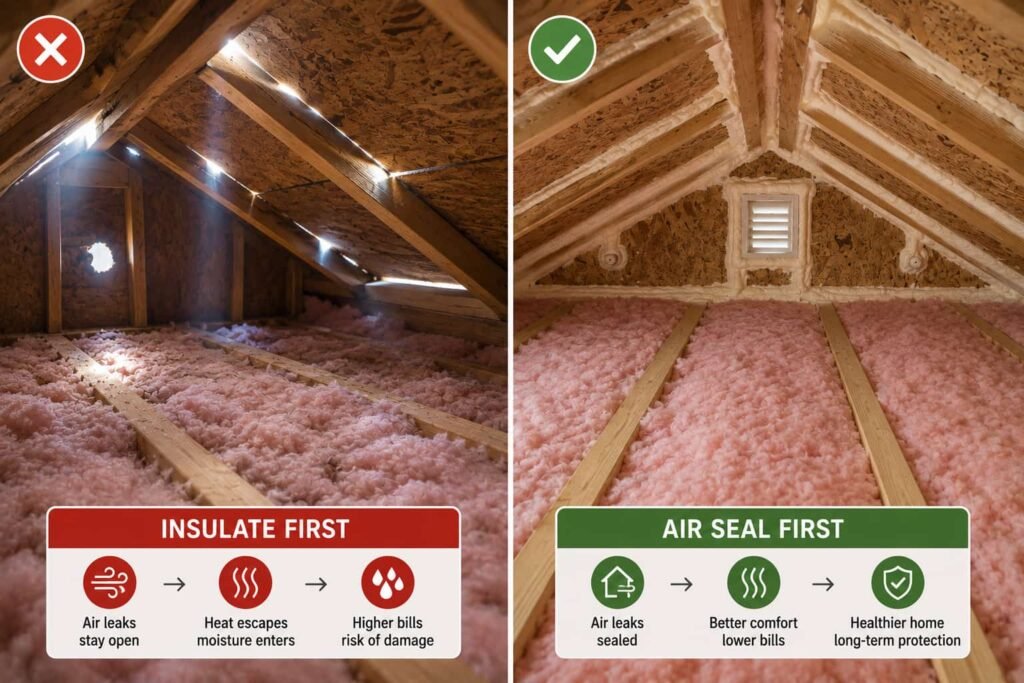
Because stack effect pushes air out at the top and pulls it in at the bottom at the same time, sealing only one end leaves the pressure difference in place and the other set of leaks keeps working just as hard. The practical order is: find the top leaks first, since that is where the pressure driving the whole system originates, then work down to the rim joist and sill plate. Skipping straight to caulking a window that "feels drafty" treats a symptom instead of the two ends actually driving the air movement through the house. Insulation added on top of unsealed gaps does not stop this air movement either; the air simply finds its way through or around the insulation, which is why the sealing has to happen first.
Where This Article Stops
Attic and rim joist work sounds simple until you are actually up there. If the attic insulation is loose, pale gray, and pebble-like, stop and call an asbestos abatement contractor before disturbing it; it may be vermiculite. If you find knob-and-tube wiring anywhere in the work area, stop and bring in a licensed electrician first, because that wiring cannot be safely buried or worked around like modern cable. And if your home has a naturally vented gas furnace, water heater, or fireplace, tightening the house changes how those appliances draw combustion air; have an HVAC technician or a certified home energy auditor check that venting still works correctly once major sealing is done, as part of the same visit that confirms your sealing actually worked.
FAQ
What is the stack effect in a house?
It is the natural movement of air caused by warm air rising and escaping near the roofline while cooler outside air is pulled in through lower openings to replace it, driven by the height of the house and the temperature difference between inside and outside.
Why does cold air come in at the bottom of my house in winter?
Cold air is denser than warm air, so it sinks and enters through the lowest available gaps: rim joists, sill plates, and foundation cracks, while warm air is escaping through the attic above it at the same time.
Does stack effect happen in summer too?
Yes, but in reverse and usually more weakly. Cool indoor air can settle and leak out near the bottom of the house while hot attic air presses in through ceiling penetrations, though the smaller temperature difference makes it less noticeable than in winter.
Can sealing my house too tightly cause other problems?
It can change how naturally vented combustion appliances draw air, which is why any major sealing project should be paired with a combustion safety check from an HVAC technician or certified energy auditor, not skipped.
How do I know if stack effect is really my problem, and not just old windows?
A blower door test will show whether air leakage is spread across the envelope rather than concentrated at the windows; if leakage shows up strongly at the attic and rim joist, stack effect, not the windows, is doing most of the damage.