The things that hurt people in attics are heat, a foot through the ceiling, wiring, hot flues, and insulation that should not be disturbed. Work early on cool days, drink water, and leave at the first sign of heat illness. Step only on joists or truss chords, never the drywall between them. Stop and call a licensed electrician for knob and tube wiring, and leave vermiculite alone. Wear a respirator, eye protection and a hard hat.
This page is about staying safe while you are up there. It is written for someone who has never worked in an attic, and it treats every stop condition as a real stop.
Attic safety tips for DIY: the stop list comes first
If you find any of these, the job pauses until the named trade has dealt with it.
| What you find | Why it stops the job | Who handles it |
|---|---|---|
| Knob and tube wiring: single wires on ceramic knobs and through ceramic tubes | Fire hazard in contact with insulation | Licensed electrician |
| Wiring that is warm, scorched, spliced outside a box, or that you cannot identify | Unknown live hazard | Licensed electrician |
| Pebble-like loose fill, gray-brown or silver-gold | May contain asbestos | Professional asbestos contractor |
| Rodent droppings or nests in quantity | Disease risk from disturbed material | Pest control, then contaminated insulation removal |
| A flue that is loose, rusted through or disconnected | Combustion gases and fire | Licensed HVAC technician |
| Wet insulation, soft decking, rotted framing | Roof leak or structural damage | Roofer, or structural engineer |
| Recessed lights you cannot confirm are IC-rated | Fire risk if covered | Licensed electrician to replace; otherwise keep clear |
ENERGY STAR's Attic Insulation Project (read September 11, 2026) lists knob and tube wiring (pre-1930) as a fire hazard when in contact with insulation, and says not to disturb vermiculite unless it has been tested by an approved lab. The EPA goes further, as covered below.
Heat: the hazard that builds while you work
An attic in summer traps heat under the roof deck, and the work is physical, in a cramped space with one way out. ENERGY STAR's tips for working in the attic (read September 11, 2026) says to start working early in hot weather, because attics heat up as the day moves on. Its air sealing project page adds: drink plenty of water.
Know the signs. The National Institute for Occupational Safety and Health, in its page on heat-related illnesses (read September 11, 2026), lists these for heat exhaustion: headache, nausea, dizziness, weakness, thirst, heavy sweating and elevated body temperature. First aid is to get out of the heat, take liquids, cool the head, face and neck with cold water, get medical evaluation, and have someone stay with the person.
For heat stroke, NIOSH lists confusion, altered mental status, slurred speech, loss of consciousness, hot dry skin or profuse sweating, and very high body temperature. That is an emergency: call 911, stay with the person, move them to shade, remove outer clothing and cool them rapidly with cold water or wet cloths and moving air.
Practical rules: work in the cool part of the day or season, take breaks outside the attic, and have someone in the house who knows you are up there.
Footing: stay on the framing
The ceiling below you is usually half-inch drywall or old plaster attached to the bottom of the joists. It will not hold a person. ENERGY STAR's guidance is to walk on joists or truss chords, not exposed ceiling drywall or insulation, to avoid falling through the ceiling.
- Find the joists before you step. Once insulation covers the floor, you cannot see where they are. Feel for them with a hand or a stick, and never step where you cannot confirm one.
- Lay boards across the joists. A sound plank or plywood strip spanning several joists spreads your weight and gives you somewhere to kneel.
- Move slowly and keep three points of contact on the framing where headroom is low.
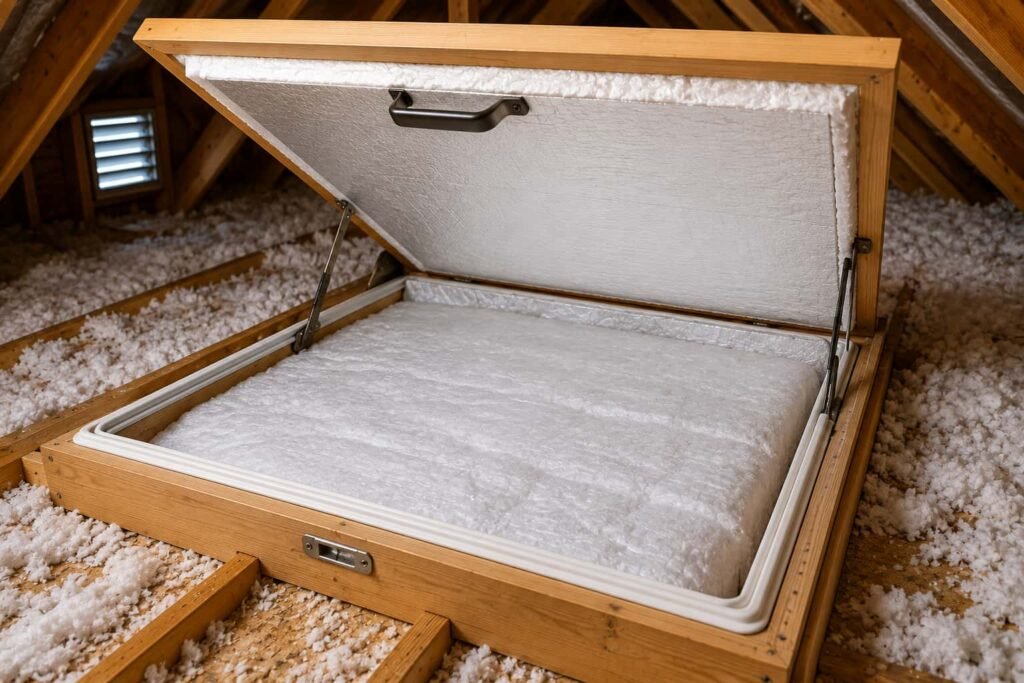
- Mind the access. Pull-down attic stairs and ladders carry a rated load on their label. Follow it, and check that the stair is firmly attached before you climb. We cover the hatch itself in attic hatch insulation. For ladder technique, follow the ladder manufacturer's instructions and OSHA's published ladder guidance.
Your head, your lungs, your skin
ENERGY STAR's attic tips warn about sharp nails sticking through the roof deck, and its project list includes a hard hat or cap for that reason. Every roofing nail above you points down.
For breathing, ENERGY STAR calls for an OSHA-approved particulate respirator or a double-strap dust mask to prevent inhalation of hazardous substances. Look for the NIOSH approval marking on the packaging. Wear it the whole time you are up there, and take it off only after you are out of the attic. A bandana or a single-strap nuisance mask is not respiratory protection.
For skin and eyes, ENERGY STAR recommends a lightweight disposable coverall, gloves and hat to keep itchy, irritating insulation off your skin, plus safety glasses. Wash work clothes separately afterwards.
Light matters too. ENERGY STAR recommends a drop light plus a flashlight. A headlamp keeps both hands free for the framing.
Wiring: what not to touch, and what not to bury
Treat every wire in an attic as live. Do not pull, move or staple cable.
Knob and tube wiring stops the job. Building America's guide to blown insulation in existing walls (read September 11, 2026) notes that the scope of National Electrical Code Article 394.1 does not allow insulation to be applied to or surround knob and tube wiring. Never bury it in insulation. A licensed electrician decides whether it is live, and what happens to it.
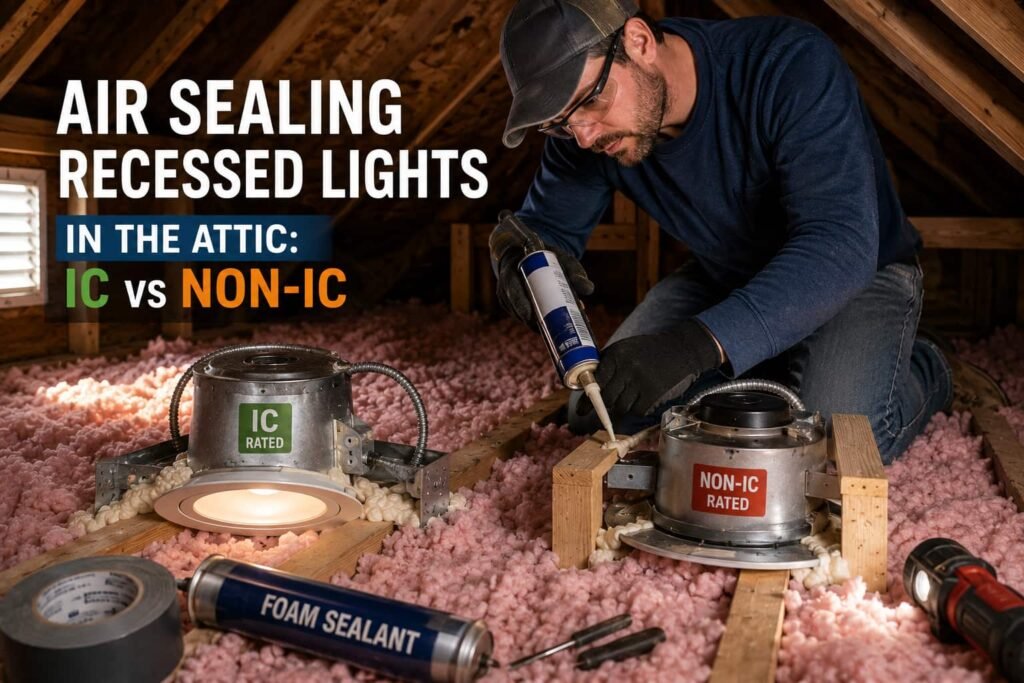
Recessed lights need clearance unless they are IC-rated. ENERGY STAR says to keep all insulation at least 3 inches away from recessed can lights unless they are rated IC, and to use sheet metal or wire mesh as a barrier around them when using loose fill. Our page on air sealing recessed lights from the attic explains how to tell the difference. Replacing a fixture is an electrician's job.
Junction boxes stay visible and reachable. Do not bury them where an electrician cannot find them later.
Flues and chimneys
A furnace or water heater flue running through the attic can be very hot. ENERGY STAR's Attic Air Sealing Project (read September 11, 2026) says building codes require 1 inch of clearance from metal flues and 2 inches from masonry chimneys to any combustible material, including insulation. Do not touch a flue with bare skin, and do not seal or insulate against it. A damaged or disconnected flue is for a licensed HVAC technician. The details of sealing around a flue chase properly are in our guide to sealing top plates and penetrations.
Insulation you should not disturb
Vermiculite. The EPA's guidance on asbestos-contaminated vermiculite insulation (read September 11, 2026) says to assume vermiculite contains asbestos and not disturb it, not to store items in that attic, and not to try to remove it yourself. If it is there, no DIY attic project goes ahead over it.
Rodent-soiled insulation. The CDC's guide on how to clean up after rodents (read September 11, 2026) says not to vacuum or sweep droppings or nesting material, because that puts particles into the air. Heavy infestations call for respirators with HEPA filters and professional help.
A short checklist before you climb
- Is it early enough in the day, or cool enough in the season?
- Does someone know you are going up, and when to check on you?
- Respirator, eye protection, hard hat, gloves, coverall, headlamp, water?
- A board or plank to lay across the joists?
- Tools gathered in advance, so you make as few trips as possible?
- Do you know what to look for on the stop list, and are you willing to stop?
Frequently asked questions
How hot is too hot to work in an attic?
We do not give a single temperature. Heat illness depends on the heat, the effort, your hydration and how used you are to it. Work in the cool part of the day, take breaks outside the attic, and stop at the first NIOSH-listed symptom.
What if I step through the ceiling?
Keep your weight on the joist you were on, and get to the framing before you try to pull free. Then leave the attic and deal with the repair separately. The prevention is simple: never step where you cannot confirm a joist.
Can I just move knob and tube wiring out of the way?
No. Do not touch it. Have a licensed electrician assess it before any insulation work continues.
Is a paper dust mask enough for attic work?
ENERGY STAR allows a double-strap dust mask as a minimum. Look for a NIOSH-approved particulate respirator. If the attic holds vermiculite or heavily soiled material, no mask makes disturbing it safe.
Sources
- ENERGY STAR, "Tips for Working in the Attic": working early, walking on joists or truss chords, nails through the roof deck, respirator or double-strap dust mask, protective clothing, lighting. Read 2026-09-11.
- ENERGY STAR, "Attic Insulation Project": knob and tube wiring, vermiculite testing, 3 inch clearance from non-IC recessed lights, barriers for loose fill, hard hat or cap. Read 2026-09-11.
- ENERGY STAR, "Attic Air Sealing Project": walking on joists, drinking water, flue and chimney clearances. Read 2026-09-11.
- NIOSH, "Heat-related Illnesses": symptoms and first aid for heat exhaustion and heat stroke. Read 2026-09-11.
- US DOE Building America Solution Center, "Blown Insulation for Cavities of Existing Exterior Walls": NEC Article 394.1 and knob and tube wiring. Read 2026-09-11.
- US EPA, "Protect Your Family from Asbestos-Contaminated Vermiculite Insulation." Read 2026-09-11.
- CDC, "How to Clean Up After Rodents." Read 2026-09-11.
Local code adoption varies, and your local building department governs what applies to your house.