The short answer on duct sealing mastic vs foil tape: use mastic on the joints you will never open again, and use a UL 181 listed foil tape on duct board, on flex duct connections, and on panels that someone will need to remove. Mastic is the more durable seal and forgives a less than perfect surface. Foil tape is cleaner and faster but only holds on a clean, dry duct. Ordinary cloth duct tape is neither. It fails on ducts, and ENERGY STAR says never to use it.
Both jobs are within reach of a careful homeowner on ducts you can see and touch. The rest of this article covers where each one goes, what the label has to say, and where the job stops.
Before you pick up a brush: where this job stops
Read this part first. Duct sealing happens in attics, crawl spaces and basements, next to equipment that burns gas or carries refrigerant and power.
- Never seal, tape or wrap a flue pipe. The metal pipe that carries exhaust from a gas furnace or water heater is a combustion vent, not a duct. Leave it, its joints and its clearances alone. Venting belongs to a licensed HVAC contractor or gas fitter.
- Do not open the furnace or air handler cabinet. Anything inside it, including the coil, the blower and the wiring, is work for an HVAC technician. Refrigerant lines are licensed work under EPA Section 608.
- Stop if you find knob-and-tube wiring anywhere in the work area, or any damaged wiring. That is a licensed electrician's call before anyone works around it.
- Stop if duct joints are wrapped in old white or gray papery material you cannot identify. In an older home, have it tested before you disturb it.
- If the house has gas appliances, keep working carbon monoxide alarms, and ask a technician about a combustion safety check after major duct work.
The attic itself is a hazard: heat, joists that are the only safe footing, nails through the roof deck. Our attic safety tips for DIY work cover what to check before you climb up.
Duct sealing mastic vs foil tape at a glance
| Duct mastic | UL 181 listed foil tape | |
|---|---|---|
| What it is | A thick paste brushed or troweled on, which cures into a flexible seal | Aluminum foil backing with a pressure-sensitive adhesive |
| Best on | Sheet metal joints, takeoffs, boots, plenum seams, odd shapes | Duct board seams, flex duct connections, removable panels |
| Surface needs | Tolerates some dust; must not be wet | Must be clean, dry and free of oil |
| Larger gaps | Needs fiberglass mesh tape embedded in it | Cannot bridge a gap on its own |
| Can you undo it? | Not cleanly | Yes |
| Mess | High; wear gloves and old clothes | Low |
| Cure time | Varies by product; read the label | Holds when pressed |
Pros often use both on one system, each where it works best. That is the approach we recommend, too.
Why duct tape is neither
Gray cloth duct tape was named for ducts, but it does not last on them. In 1998, researchers Max Sherman and Iain Walker at the U.S. Department of Energy's Lawrence Berkeley National Laboratory ran duct sealants through three months of accelerated aging, with hot and cold air cycled through the joints and separate bake tests that simulated attic heat. Only one duct tape product survived. Eleven failed within days, and some fell off the joints entirely.
The other materials in the test held up. Those included mastic, foil-backed tape, clear plastic tape and the aerosol sealant developed at the lab. "Of all the things we tested, only duct tape failed," Sherman said in the lab's release.
ENERGY STAR gives the same advice in fewer words. Its duct sealing guide, which we read on September 27, 2026, recommends mastic sealant or metal tape and says to "never use duct tape, as it is not long-lasting." If your ducts already have old cloth tape on them, treat every one of those joints as unsealed.
Reading the label: UL 181A and UL 181B
The foil tape in the hardware aisle is not all duct tape. The printed listing tells you which duct a product is meant for.
- UL 181A covers closure products for rigid fiberglass duct board. Look for 181A-P on pressure-sensitive tape, 181A-H on heat-activated tape and 181A-M on mastic.
- UL 181B covers closure products for flexible duct. Look for 181B-FX on tape and 181B-M on mastic.
The International Residential Code, in section M1601.4.1, calls for these markings on closure systems used with duct board and flex duct. That is a model code. Adoption and amendments vary by state and city, and your local building department or inspector decides what applies to your house.
A tape marked only 181B-FX is not listed for duct board. Some tapes carry both listings. Read the printing on the tape itself, not just the box.
The listing tells you what a product is for. It does not make a sheet metal joint last longer than mastic would. On metal, mastic remains the durable choice, and tape is the choice for places that need to come apart.
Where duct leaks usually are
ENERGY STAR's duct sealing page says that in a typical house about 20 to 30 percent of the air moving through the duct system is lost to leaks, holes and poorly connected ducts. Most of it escapes at the same few places:
- Boots: where the duct meets the register box, and where that box meets the ceiling or floor.
- Takeoffs: where a branch leaves the main trunk.
- Trunk seams and end caps: long joints that were crimped and never sealed.
- The supply plenum: the box on top of the furnace or air handler, where it joins the trunk. Seal the plenum's outside seams, not the cabinet.
- The return side: panned joist returns, return boxes and the filter slot, which often pull in dusty attic or crawl space air.
- Flex connections: where the inner core meets a metal collar.
If you have not found your leaks yet, a smoke pencil test for air leaks shows where air moves while the blower runs. Turn the system off before you seal anything.
Sealing a joint with mastic, in order
- Shut the system off at the thermostat so the blower does not push air through wet mastic.
- Wipe off loose dust and debris. Mastic tolerates a little grime, but not grease or water.
- Check the joint is fastened. A seal is not a fastener. Metal joints need sheet metal screws or crimps holding them together first. A loose joint that only mastic holds will crack open.
- For a gap too wide for mastic alone, lay fiberglass mesh tape across it. The mastic label states the largest gap it can bridge by itself. Mesh gives the mastic something to grip.
- Brush or trowel the mastic on thick, covering the seam and the mesh completely, with a margin on both sides. Follow the manufacturer's coverage guidance on the label.
- Let it cure before you run the system. Cure time depends on the product, temperature and humidity.
Wear gloves and eye protection. Mastic drips, and you will be working overhead in an attic or on your back in a crawl space.
Using foil tape so it actually holds
Foil tape fails for one main reason: it went onto a dirty or damp surface. Treat surface prep as the job.
- Clean the surface with a dry rag. If there is oil or residue, use the cleaner the tape maker specifies and let it dry.
- Apply it flat and centered over the seam, with no wrinkles or folds. A wrinkle is a channel air will find.
- Press it down hard, ideally with a plastic squeegee, working out from the center. Pressure-sensitive adhesive needs pressure.
- On flex duct, fasten the inner core to the collar with a clamp or strap first, then tape. Tape alone will not hold a flex connection.
- Use it on anything a technician will open, such as filter doors and access panels outside the cabinet. Mastic there turns routine service into a scraping job.
Keep the tape's liner on until the moment you place it. Dust in an attic settles fast.
What to leave alone
Sealing a return leak near a gas furnace can change pressures in that space. That is a good change for efficiency, but it is also why we suggest a combustion safety check by an HVAC technician after major duct work in a house with gas appliances.
Beyond the flue pipe and the equipment cabinet, leave these alone:
- Combustion air openings into a furnace closet or room. They are there on purpose.
- Bath and kitchen exhaust ducts are a separate system with their own rules. Do not tie them into the heating and cooling ducts.
- Ducts you cannot reach without cutting into a wall or ceiling. Those are a contractor job, sometimes done with an aerosol sealant blown in from the inside.
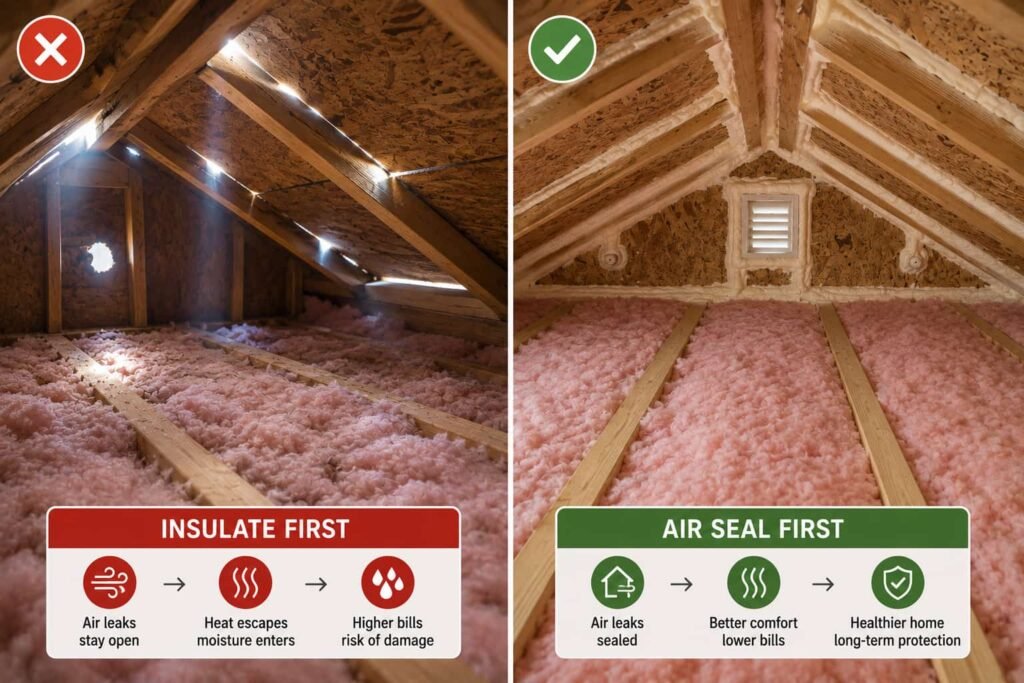
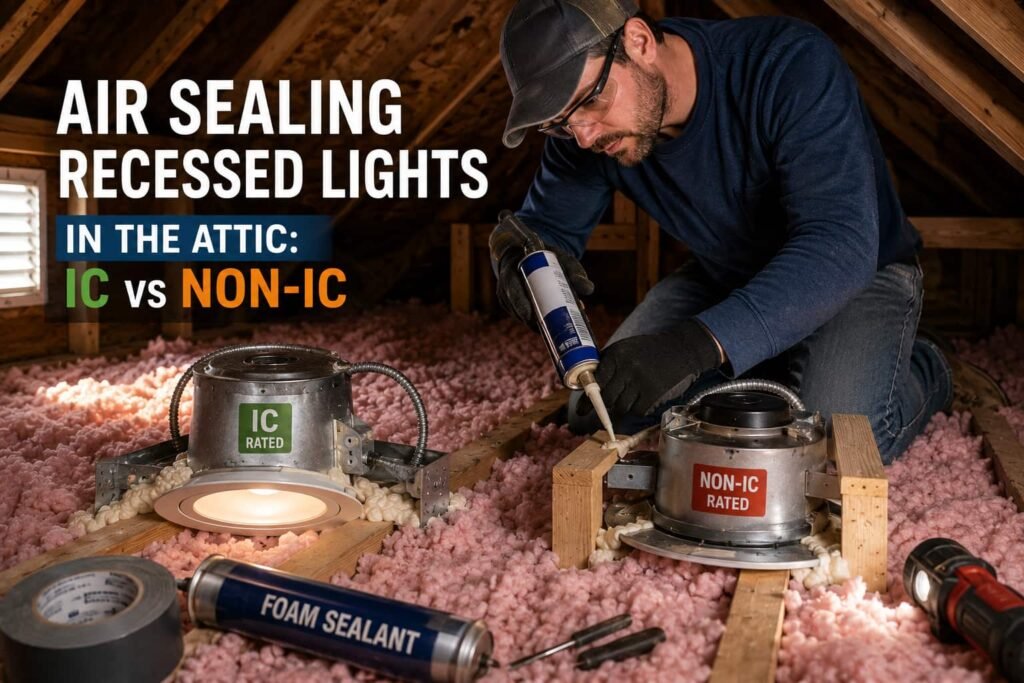
Duct sealing is also only one part of the house. The ceiling and top plates around the ducts leak too, and sealing before you insulate keeps the order right. For gaps in wood framing rather than ducts, our guide to caulk, foam and backer rod matches each sealant to each gap.
FAQ
Is mastic better than foil tape for sealing ducts?
For permanent sheet metal joints, yes. Mastic is more durable, tolerates a less than perfect surface, and can be reinforced with mesh over larger gaps. Foil tape is the better pick for duct board, flex connections and panels that need to come off again, as long as it carries the right UL 181 listing.
Can I use regular duct tape on ducts?
No. ENERGY STAR says never to use it on ducts, and Lawrence Berkeley National Laboratory testing in 1998 found that cloth duct tape failed quickly under attic-like conditions while mastic and foil-backed tape held.
What does UL 181 mean on foil tape?
It is a listing for duct closure products. UL 181A (marked 181A-P, 181A-H or 181A-M) is for rigid fiberglass duct board. UL 181B (marked 181B-FX or 181B-M) is for flex duct. Check that the marking matches your duct type.
Can I seal the ducts on top of my furnace?
You can seal the outside seams of the supply plenum and trunk connections. Do not open or seal the furnace or air handler cabinet, and never tape or seal the flue pipe. Those belong to a licensed HVAC technician.
Do I need to seal ducts before insulating them?
Yes. Insulation slows heat flow, but air still leaks through unsealed joints underneath it. Seal every reachable joint first, then insulate.