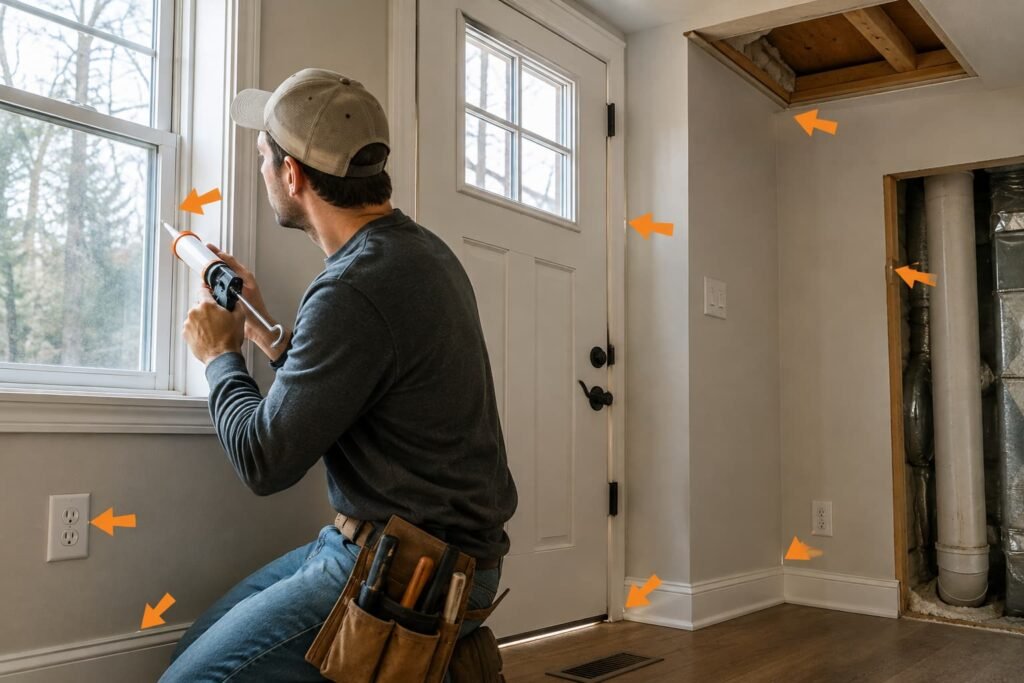
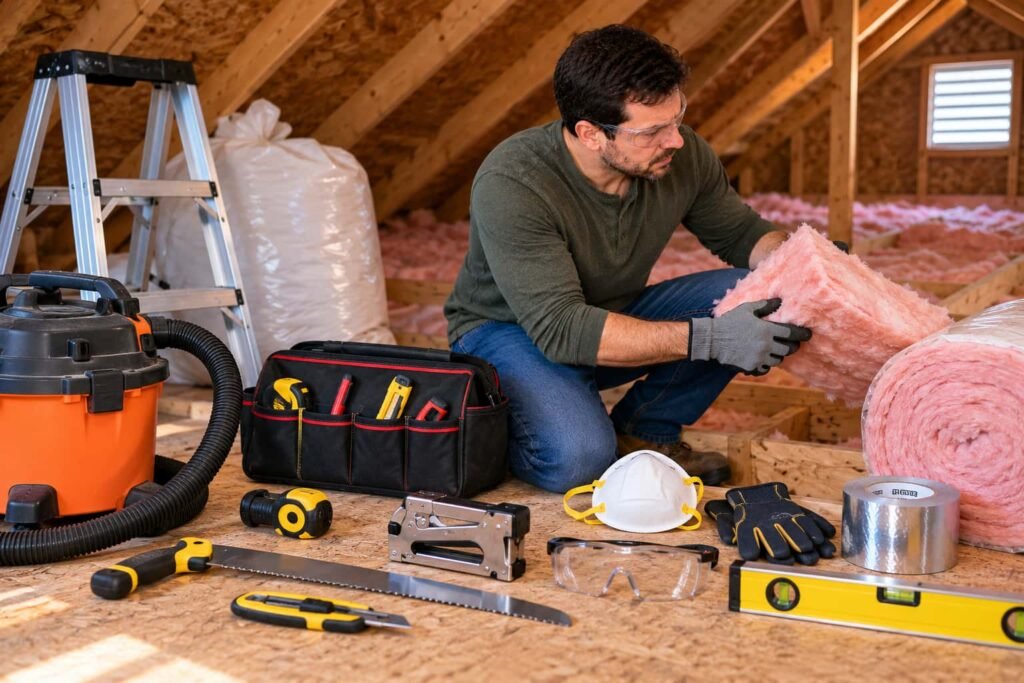
The list is shorter than the aisle suggests, and the item people skip is protective equipment rather than a tool. ENERGY STAR's own attic project list is a good spine: safety glasses, gloves and a dust mask or protective face mask, a flashlight or portable safety light, boards to walk on, a hard hat or cap, a bucket to haul materials, a retractable utility knife, sheet metal scissors, a tape measure, a staple gun, a caulk gun and cans of expanding foam.
We name no brands, publish no ranking and print no prices. What follows is why each item is on the list, and what goes wrong when it is missing.
Protective equipment is the part that is not optional
Loose insulation fibers are a recognized respiratory irritant, which is why the National Institute for Occupational Safety and Health sets a recommended exposure limit for fibrous glass of 3 fibers per cubic centimeter as a time weighted average, along with a total mass limit of 5 milligrams per cubic meter. The homeowner implication of that figure is simple: a bandana over the face is not respiratory protection. Buy a NIOSH-approved filtering facepiece, wear it for the whole time you are up there, and take breaks outside rather than pulling it off in the attic.
Around the rest of you: safety glasses that seal reasonably at the sides, gloves, long sleeves and long pants, and closed shoes. ENERGY STAR also lists a hard hat or cap, for the very practical reason that an attic roof deck is full of roofing nail points at head height. Wash work clothes separately afterwards.
If the attic holds vermiculite or any unidentified loose fill you cannot account for, no mask on this list is the answer. The EPA advises leaving vermiculite undisturbed because it may contain asbestos, and testing comes before anyone goes up there to work.
Own, rent or borrow
| Tool | Own, rent or borrow | Why it is on the list |
|---|---|---|
| NIOSH-approved filtering facepiece, safety glasses, gloves | Own | The exposure above, and cheap enough that sharing one is a false economy |
| Portable work light, plus a headlamp | Own | Attic wiring is not lighting, and one hand should stay free |
| Boards or a plank to kneel and walk on | Borrow or make | Prevents the foot through the ceiling that ends the project |
| Utility knife with plenty of blades | Own | Insulation blunts blades fast, and a blunt blade is when hands slip |
| Insulation knife or a long serrated blade | Own | Cuts batts cleanly against a straightedge instead of tearing them |
| Tape measure and a straightedge | Own | Batt width is a fit problem, not a measurement problem |
| Caulk gun | Own | The small-gap half of the sealing work |
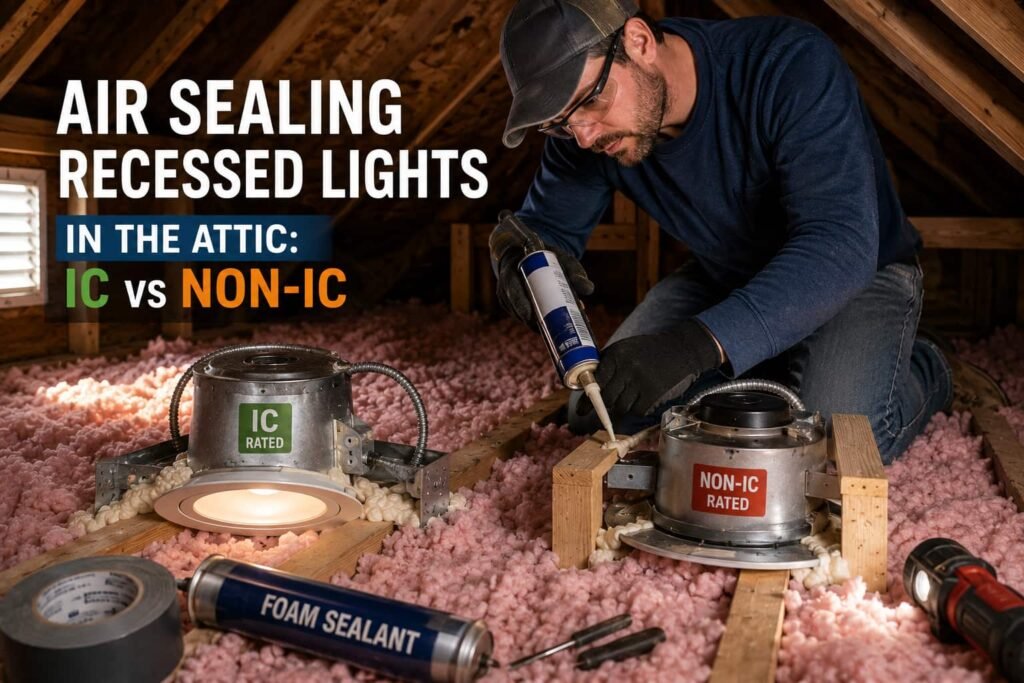
| Foam gun with a metal applicator | Own if the list of penetrations is long | Far more control than a straw can, and the can can be left attached between sessions |
| Staple gun, or hammer and nails | Own | Baffles, blocking and flashing all need fixing in place |
| Sheet metal scissors and aluminum flashing | Own for the job | The only correct material near a flue, see below |
| Depth rulers or a marked stick | Own | Turns a target R-value into something you can actually verify in place |
| Insulation blower | Rent | See below |
| Large bucket, and rubble bags | Own | Getting material up and rubbish down without a second trip |
| Knee pads | Own | Joists are 1.5 inches wide and you will be on them for hours |
The blower is a rental, and it comes with conditions
An insulation blower is the one big machine in this job, and buying one makes no sense for a single attic. Retailers commonly lend or rent the machine with a minimum bag purchase, which is why so many pages describe blown-in as a weekend job.
The condition worth knowing before you commit is that it is a two person job. One person feeds bags into the hopper at ground level and one works the hose in the attic, and the two need to talk to each other. Add the hose run, the power supply, and the fact that the person in the attic cannot see the hopper. We go through the realities of that day, including the machine setup and the material yield question, in our page on renting the blower for a blown-in attic. If you have not yet decided between loose fill and batts, that decision comes first and it is covered in our comparison of blown-in and batt insulation.
Tools that exist to stop you making a specific mistake
Three items on the list are there for reasons that are not obvious.
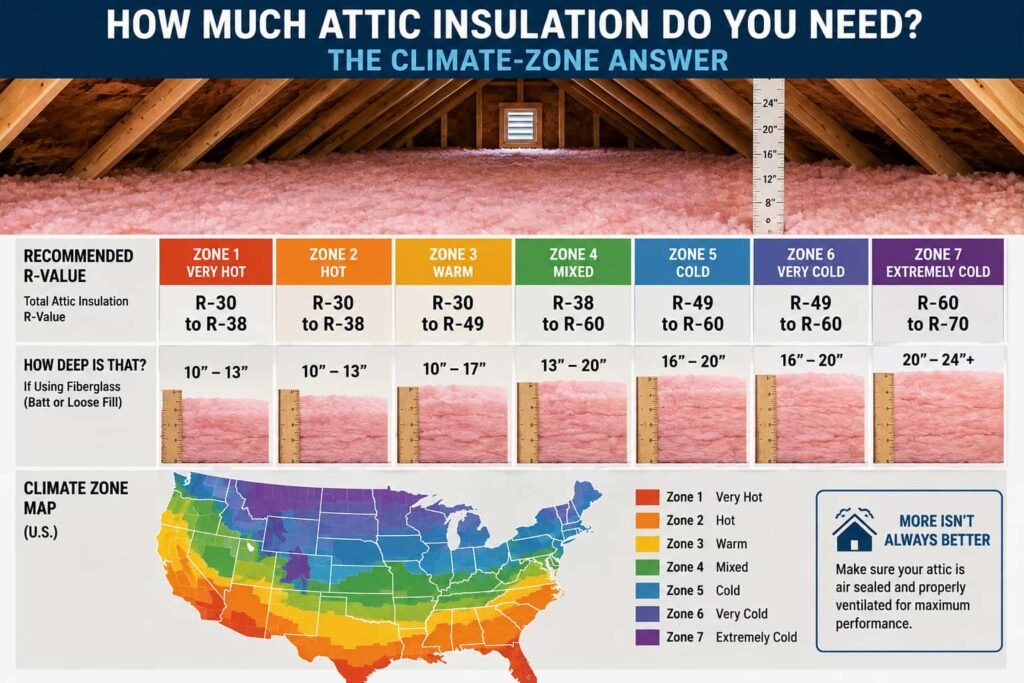
Depth rulers. Insulation performance is depth plus coverage, and both are impossible to judge by eye once the attic is white. Rulers stapled to the joists at intervals let you check as you go instead of measuring after the material is down. The target itself is a climate zone lookup in your adopted energy code, and the way that lookup works is in our page on what the code table asks for by zone.
Baffles and a staple gun. Insulation pushed into the eaves blocks the soffit vents and stops the roof assembly breathing, which causes moisture problems that cost more than the heat you saved. Baffles hold the insulation back. That whole subject is covered in baffles, soffit vents and why insulation must not block them.
Aluminum flashing and sheet metal scissors. ENERGY STAR states that building codes require 1 inch of clearance from metal flues and 2 inches from masonry chimneys to any combustible material, including insulation, and that these gaps are sealed with lightweight aluminum flashing and special high temperature heat resistant caulk. It says plainly not to use spray foam there. The flashing forms a dam that keeps insulation off the hot pipe. That is a fire clearance requirement, not a finishing preference.
The tools that do not help, and the order that does
A thermal camera is a diagnostic tool for the audit stage, not an installation tool, and it will tell you very little in an attic you are about to fill. A moisture meter is worth having only if you already suspect a leak, in which case the leak is the project. Nothing on this list fixes wet insulation, and nothing on it fixes a roof.
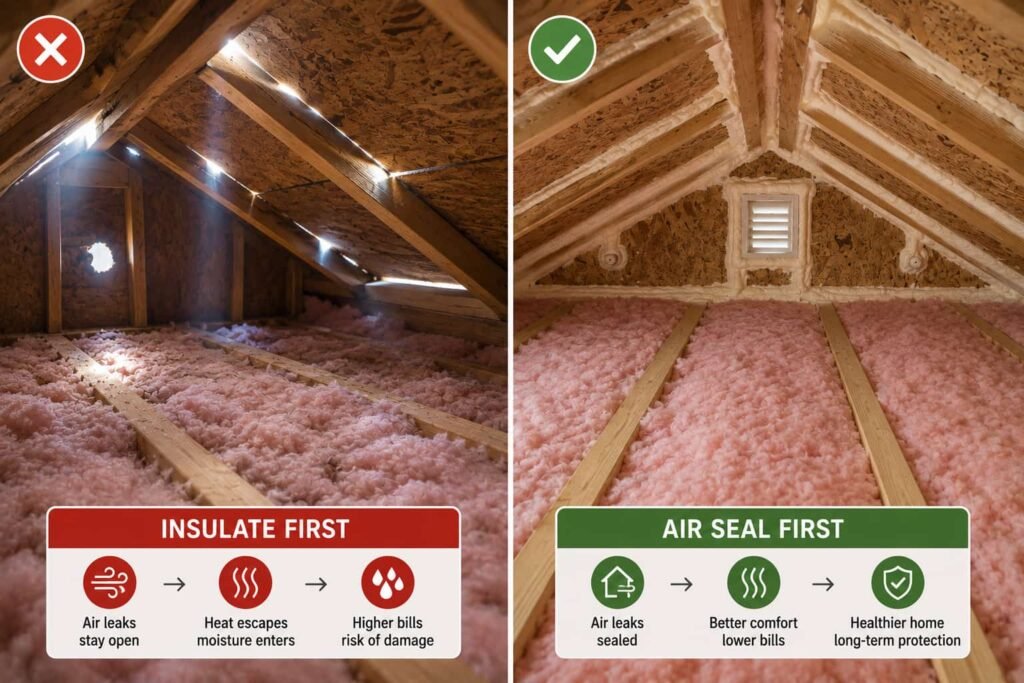
The larger point is sequencing. Every tool above is wasted if the insulation goes down before the air sealing, because you cannot reach the top plates and penetrations afterwards without pulling the material back off. The reasoning is set out in why air sealing comes before insulation, and the specific attic-floor targets are listed in our guide to sealing top plates, wire holes and pipe penetrations. Buy the caulk gun and the foam gun for that stage, and the blower afterwards.
What no tool on this list can deal with
Stop and get someone qualified if you find any of these.
Knob and tube wiring, recognizable as individual conductors running through ceramic tubes and knobs, common in houses built before about 1930. Insulation in contact with it is a fire hazard, and the whole job stops until a licensed electrician has looked at it. Any wiring that is warm, scorched, spliced outside a box, or that you simply cannot identify, gets the same treatment.
A furnace or water heater flue that is loose at a joint, rusted through, or missing its storm collar. That is a licensed HVAC technician's work, and combustion venting is not something to seal around and hope.
Vermiculite or unidentified loose fill, as above. Wet or matted insulation, which is a symptom of a roof leak or a bathroom fan venting into the attic rather than outside. Any structural member that looks cracked, cut or notched, which is a structural engineer's question.
And one that is easy to underestimate: heat. An attic in summer is a heat stress environment with poor footing, low headroom and one exit. Work early in the day, take breaks, drink water, and do not go up alone if you can avoid it. Getting up and down safely is its own subject, and the instructions on your ladder plus the guidance published by OSHA are the authorities on it, not this page.
Frequently asked questions
Do I need a full respirator or is a dust mask enough?
Look for a NIOSH approval on the packaging rather than the word mask. ENERGY STAR's own project list specifies a dust mask or protective face mask, and NIOSH's exposure limit for fibrous glass is the reason to take that seriously rather than improvise. If the material in the attic is unidentified, or if there is any suspicion of asbestos containing vermiculite, no filtering facepiece makes the job safe and the answer is testing first.
Can I do an attic alone?
Air sealing, yes, with the safety points above. Blowing loose fill, no. The machine needs someone at the hopper, and working alone in an attic with a hose and poor footing is how a small problem becomes a serious one.
What can I substitute for boards to walk on?
Any sound plank long enough to span at least three joists, laid across them. What you cannot substitute is judgment: never step on drywall between joists, and never step where you cannot see the joist under the insulation.
Is a foam gun worth it over the straw cans?
If the job is a handful of penetrations, straws are fine. If it is a full attic plane with dozens of top plate gaps, wire holes and pipe penetrations, a gun applicator gives finer control, less waste and the ability to stop and restart without losing the can. That is a judgment about the size of your list, not about which product is better.
Do I need anything different for cellulose versus fiberglass?
The blower and the protective equipment are broadly the same, and the difference shows up in dust volume and in how the material settles. Both materials have safety data sheets, and the manufacturer's own document is the one that governs handling, not a general article.
Sources
- ENERGY STAR, "Attic Air Sealing Project" (energystar.gov): the materials and safety list including safety glasses, gloves and dust mask or protective face mask, flashlight or portable safety light, boards to walk on, hard hat or cap to protect the head from sharp roofing nails, large bucket, unfaced fiberglass insulation and garbage bags, 14 inch wide aluminum flashing, retractable utility knife and sheet metal scissors, tape measure and staple gun, silicone or acrylic latex caulk and caulk gun, cans of expanding spray foam, and high temperature heat resistant caulk; the instruction to walk on joists or truss chords rather than exposed drywall or insulation; the warning about nails through the ceiling and roof deck; the caution that furnace flues can be very hot; and the requirement of 1 inch of clearance from metal flues and 2 inches from masonry chimneys to any combustible material including insulation, sealed with aluminum flashing and high temperature caulk rather than spray foam. Accessed 2026-09-07.
- National Institute for Occupational Safety and Health, NIOSH Pocket Guide to Chemical Hazards, fibrous glass dust: recommended exposure limit of 3 fibers per cubic centimeter as a time weighted average, and 5 milligrams per cubic meter total. Accessed 2026-09-07.
- US Environmental Protection Agency guidance on vermiculite insulation, which advises leaving it undisturbed because it may contain asbestos and having it evaluated rather than disturbed. Accessed 2026-09-07.
- Occupational Safety and Health Administration published guidance on ladders and on working at height, named here as the authority on access rather than reproduced.
Product handling instructions and safety data sheets from the manufacturer of the material you buy override any general guidance here. Building code requirements, including clearances, vary by state and locality, and your local building department or inspector governs what applies to your house.