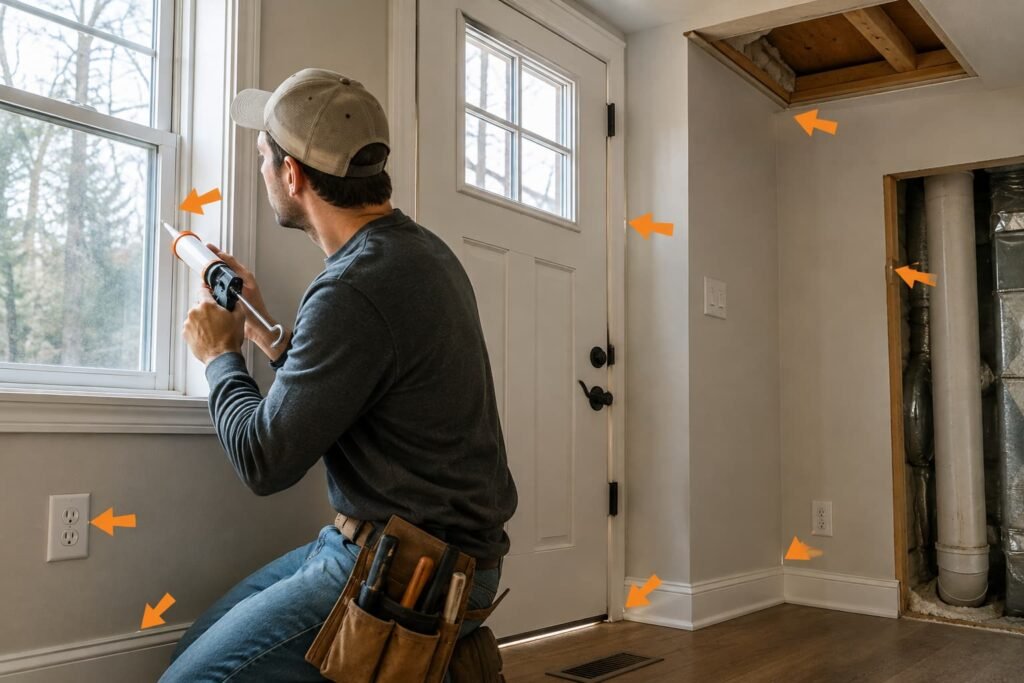
Doing attic insulation yourself usually costs less cash and more time, labor and risk, and the size of that gap depends on your attic, not a national average. ENERGY STAR rates a DIY attic insulation job as moderate to difficult over one to three days, and puts a contractor job one cost tier higher over one to two days. A dry, open, hazard-free attic favors DIY. Tight access, wet insulation, old wiring or vermiculite favor hiring.
You will not find a dollar figure on this page. Where no public source gives a number for your house, we state the variables and refuse the number. What follows is how to work out which side of the line your attic sits on, and how to read a quote once you have one.
Why this page has no price table
Most pages ranking for this question open with a per-square-foot range for DIY and another for professional work. Put three of them side by side and the ranges disagree, and none says which region, which year or which attic the numbers came from. A figure like that is a guess about someone else's house.
Your real number is set by things a national average cannot know: the area of your attic floor, how much insulation is already there, the depth your climate zone calls for, local labor rates, the material you choose, and what is in the way. Those are the variables. The only reliable price for your attic is a written quote for your attic, and the only reliable DIY figure is the one you build from local material prices and your own measurements.
The one official comparison we can point to is ENERGY STAR's own Attic Insulation Project page (read September 11, 2026). It shows cost as dollar-sign tiers rather than dollars: the do-it-yourself job at three signs, the contractor job at four.
Attic insulation cost, DIY vs professional: what you pay for on each side
The two routes buy different things, so compare lines, not totals.
| Cost line | DIY | Professional |
|---|---|---|
| Insulation material | You buy it at retail | Included in the quote |
| Blower for loose fill | Rented or lent with a bag purchase | Contractor's own truck-mounted or portable machine |
| Air sealing materials | Foam, caulk, flashing, bought separately | Included only if the quote says so |
| Baffles, hatch dam, light covers | Bought and fitted by you | Included only if listed |
| Protective equipment | Respirator, eye protection, coveralls | The crew's cost, not yours |
| Labor | Your days, plus a second person for the blower | Crew hours |
| Removal and disposal of old material | Your problem, if needed | A separate line if needed |
| Fixing a mistake | Your cost, later | The contractor's, if the work is warrantied |
The last row is the one most DIY savings estimates skip. We cover the machine side of the DIY route in our page on renting the blower for a blown-in attic, and the material choice in blown-in vs batt insulation for an attic you do yourself.
The factors that move the number, whichever way you go
Attic floor area. Material scales with it, and so does labor.
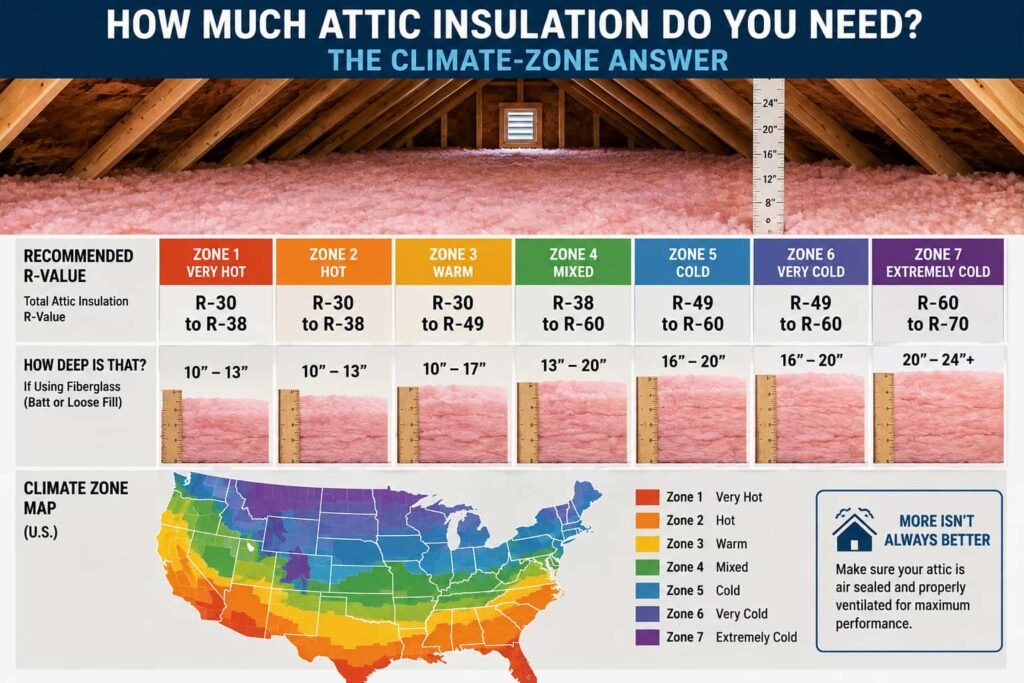
Existing depth versus target depth. ENERGY STAR's recommended R-values by climate zone (read September 11, 2026), based on the 2021 IECC Table R402.1.3, list R30 for an uninsulated attic in Zone 1, R49 in Zones 2 and 3, and R60 in Zones 4 through 8. Where 3 to 4 inches already exist, the targets drop to R25, R38 and R49 respectively. Topping up costs less than starting from bare joists. Your local code governs, and our page on how much attic insulation you need by climate zone walks through the lookup.
Access. A walkable attic with a stair is a different job from a low-slope roof with a scuttle hole in a closet.
Preparation. Air sealing, baffles, and dams around the hatch and flues all come before insulation.
Removal. Wet, moldy, contaminated or suspect material has to come out first, and that is often the biggest swing in the whole job.
Local labor market. Contractor pricing follows local demand and season.
When DIY holds up
ENERGY STAR's Getting Started guide (read September 11, 2026) puts it plainly: attic air sealing and adding insulation are do-it-yourself projects if your attic is accessible and not too difficult to move around in.
In practice DIY holds up when all of these are true:
- The attic has headroom to kneel and move, and joists or truss chords you can see and stay on.
- The existing insulation is dry, with no stains on the roof deck above it.
- There is no knob and tube wiring, no vermiculite and no sign of rodents.
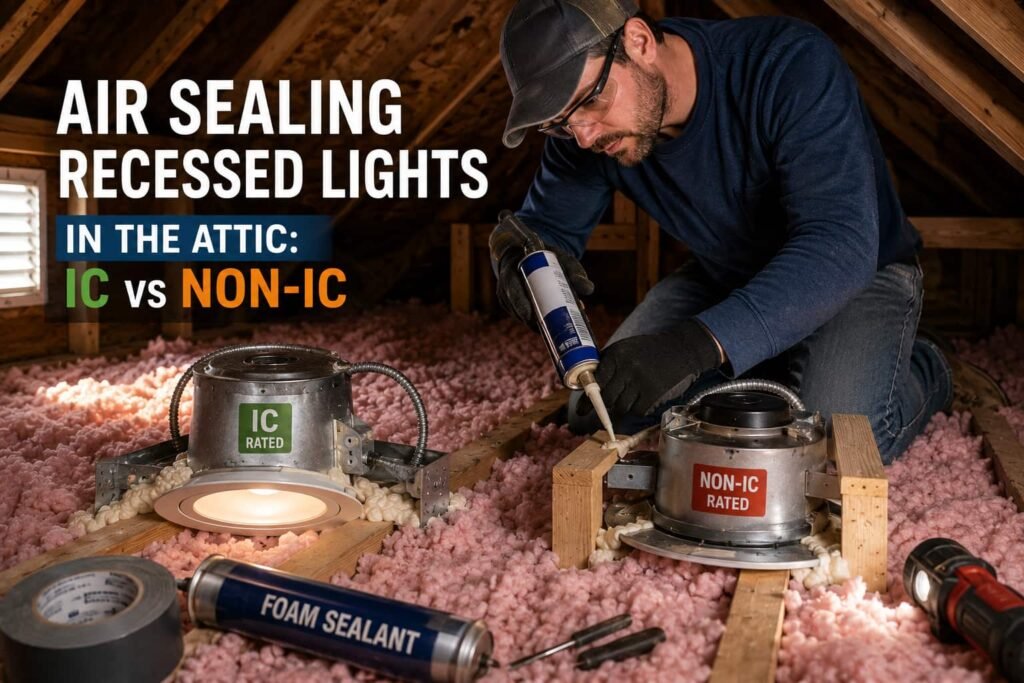
- Recessed lights are few, and you know which are IC-rated.
- You have a second person for blowing loose fill, and you can work early in the day in summer.
- You are willing to do the air sealing first rather than skip it.
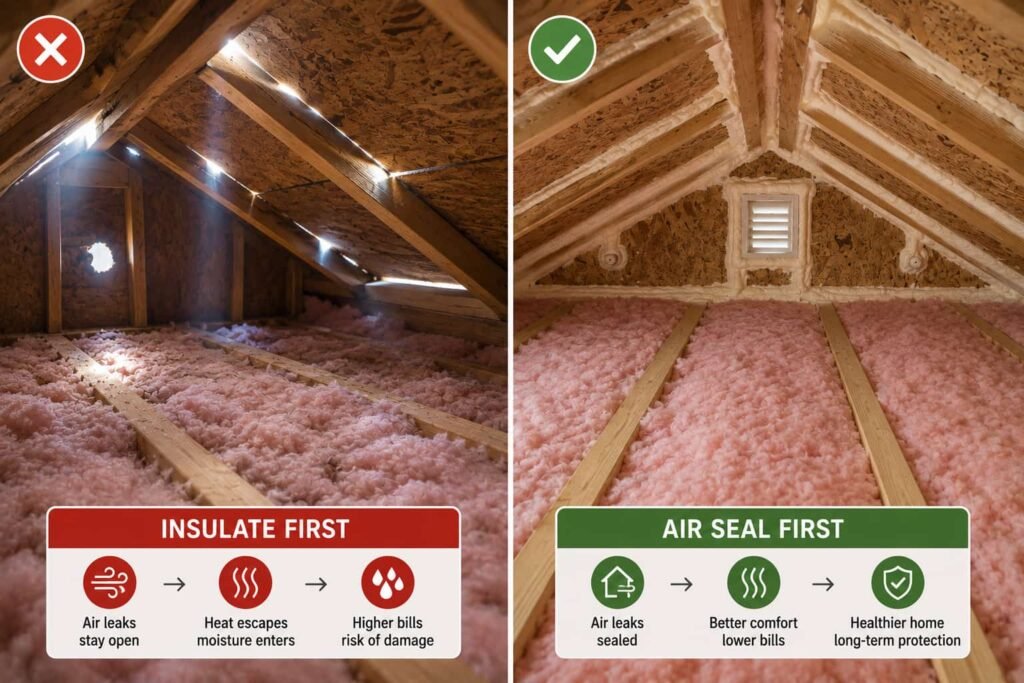
That last point is where DIY savings quietly disappear. Insulation laid over unsealed top plates and penetrations has to be pulled back to fix them later. The reason the order matters is set out in why air sealing comes before insulation.
When hiring is the cheaper decision
ENERGY STAR's Attic Air Sealing Project (read September 11, 2026) lists the conditions under which it recommends a contractor: difficult attic access and limited space to work, wet or damp insulation indicating a leaky roof, moldy or rotted rafters or floor joists, kitchen or bathroom vents exhausting into the attic instead of outdoors, little or no attic ventilation, and knob and tube wiring from before about 1930. Its Getting Started guide adds a history of ice dams and many uninsulated recessed lights.
Each of those is also a cost driver. It changes the job from adding material to fixing a problem, and fixing the problem is work a homeowner often cannot finish. Knob and tube wiring is a licensed electrician's call before any insulation goes near it. A wet attic points to a roofer or a venting fix first.
Vermiculite is the hard stop. The EPA's guidance on asbestos-contaminated vermiculite insulation (read September 11, 2026) says to assume it contains asbestos, not to disturb it, not to try to remove it yourself, and to hire a professional asbestos contractor for any work that would disturb it. No DIY saving survives that.
The costs DIY estimates leave out
A DIY figure built from the price of bags is a best case. The real one also carries:
- Rework. Insulation pushed into the eaves blocks soffit vents. Insulation against a non-IC recessed light is a fire risk. Either one means going back up and pulling material out.
- Overbuying or underbuying. Loose fill is sold by coverage chart, and depth is easy to misjudge by eye.
- Your time. One to three days, by ENERGY STAR's rating, in a hot space with poor footing.
- Injury. A foot through the ceiling drywall is a repair bill as well as a fall.
None of these apply to every attic. They are why a DIY estimate should carry a margin.
A decision table by factor
| Factor | Points toward DIY | Points toward hiring |
|---|---|---|
| Access | Walk-up stair, headroom | Scuttle in a closet, low slope |
| Existing material | Dry fiberglass or cellulose | Wet, moldy, rodent-soiled, or vermiculite |
| Wiring | Modern cable, no splices outside boxes | Knob and tube, or anything you cannot identify |
| Recessed lights | Few, all IC-rated | Many, or unknown rating |
| Ventilation | Clear soffits, working baffles | Little or none, bath fans venting into the attic |
| Labor | Two people, cool season | One person, peak summer |
| Scope | Top-up over sealed, clean floor | Removal, sealing and insulation together |
If most of your answers land in the right column, the cheaper choice on paper is rarely the cheaper choice in practice.
How to compare contractor quotes without a price guide
Get more than one quote for the same scope, then compare line by line. A complete quote names:
- The target R-value, the material, and the installed depth from the manufacturer's coverage chart.
- Whether air sealing is included, and which penetrations: top plates, wire and pipe holes, the flue chase, the hatch.
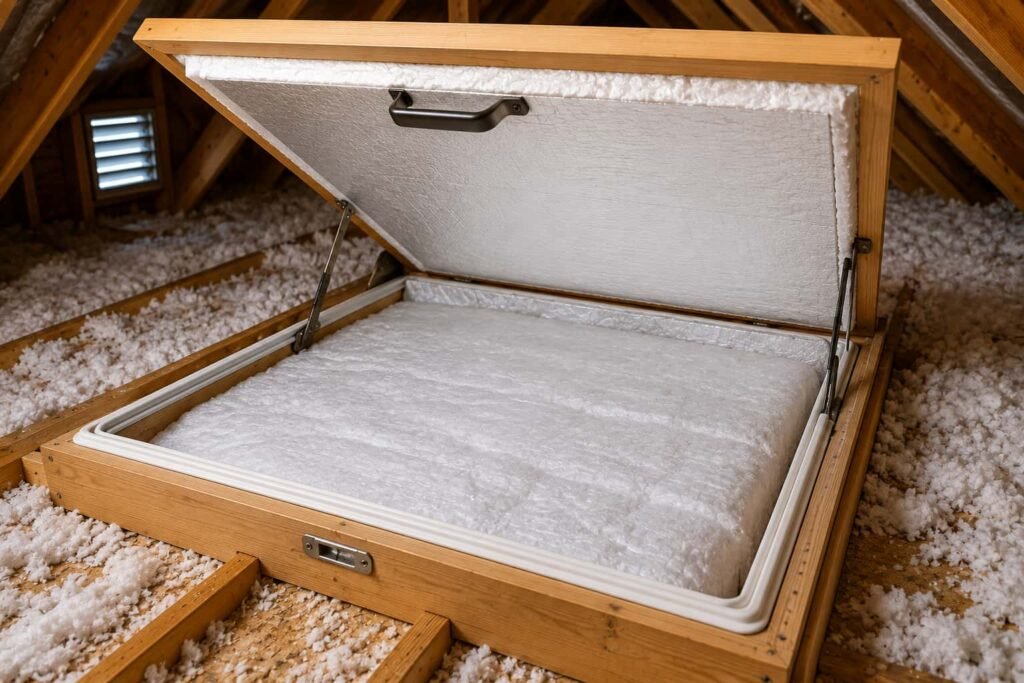
- Baffles at every soffit bay, and a dam around the hatch.
- How recessed lights and flue clearances will be handled.
- Removal and disposal, if any, as its own line.
- Depth markers left in place, so you can check the result.
A quote that only says "blow insulation to R-49" leaves out most of what separates a good job from a cheap one. A low quote that skips the sealing is not comparable to a higher one that includes it.
Frequently asked questions
Is DIY attic insulation always cheaper than hiring?
In cash outlay it usually is, because you are not paying for labor. In total cost it depends on the attic. ENERGY STAR itself recommends a contractor where access is difficult, insulation is wet, or knob and tube wiring is present, and in those attics a DIY attempt can end up costing more.
Why won't you give a price per square foot?
Because we have not found a public source that gives one for your region, year and attic. The ranges printed elsewhere disagree with each other. A written local quote, or your own material list priced locally, is the number to trust.
Does ENERGY STAR say how much I will save?
ENERGY STAR's Why Seal and Insulate page (read September 11, 2026) says EPA estimates homeowners can save an average of 15% on heating and cooling costs, or an average of 11% on total energy costs, by air sealing their homes and adding insulation in attics, floors over crawl spaces and basements. That is a national average, not a prediction for your house.
Can I do the air sealing myself and hire out the insulation?
Yes, and it is a common split. Seal first, then have the contractor quote insulation over a floor that is already sealed, and make sure the quote does not charge you again for sealing you have done.
Sources
- ENERGY STAR, "Attic Insulation Project": difficulty, time and cost-tier ratings for DIY and contractor work; safety equipment; vermiculite and knob and tube cautions; 3 inch clearance from non-IC recessed lights. Read 2026-09-11.
- ENERGY STAR, "Attic Air Sealing Project": conditions under which to hire a contractor; walking on joists or truss chords. Read 2026-09-11.
- ENERGY STAR, "Getting Started" (do-it-yourself guide): when attic sealing and insulation are DIY projects; added hire conditions. Read 2026-09-11.
- ENERGY STAR, "Recommended Home Insulation R-Values," based on 2021 IECC Table R402.1.3. Read 2026-09-11.
- ENERGY STAR, "Why Seal and Insulate?": the EPA average savings estimate. Read 2026-09-11.
- US EPA, "Protect Your Family from Asbestos-Contaminated Vermiculite Insulation." Read 2026-09-11.
State and local code adoption varies, and your local building department governs what applies to your house.