Pick the material by the job, not the label. For an open attic floor, blown fiberglass or cellulose both work, but cellulose settles more, so install it to the settled depth on the bag. For closed walls, dense-packed cellulose or fiberglass is the usual retrofit. For open stud bays, batts of fiberglass or mineral wool. For a damp basement wall, none of the three belongs against the concrete. Compare products by the labeled R-value and installed depth, not by R-per-inch claims.
We name no brands and publish no ranking. We have not tested any of these products. What follows is how the three differ in ways that change a decision, taken from US Department of Energy and federal sources.
What the three materials are
The US Department of Energy's Building America Solution Center, in its loose-fill insulation reference (read September 11, 2026), describes all three:
- Cellulose is made from recycled newspaper and boxes, treated with fire retardant.
- Fiberglass is spun glass fiber, lighter than cellulose.
- Rock wool, one form of mineral wool, is spun from molten material such as blast-furnace slag.
All three come as loose fill for blowing. Fiberglass and mineral wool also come as batts and rolls. Cellulose is almost always blown or dense-packed rather than sold as batts.
Cellulose sold as a consumer product in the US is covered by a Consumer Product Safety Commission standard. Under 16 CFR 1209.9 (read September 11, 2026), every container must carry the statement "This product meets the amended CPSC standard for flame resistance and corrosiveness of cellulose insulation." If the bag does not say it, do not buy it.
Fiberglass vs cellulose vs mineral wool at a glance
| Fiberglass | Cellulose | Mineral wool | |
|---|---|---|---|
| Made from | Glass fiber | Recycled paper with fire retardant | Rock or slag fiber |
| Forms | Batts, rolls, loose fill | Loose fill, dense-pack | Batts, loose fill |
| Settling as loose fill (Building America) | 2 to 4 percent | 10 to 20 percent | 2 to 4 percent |
| Handles like | Light, springy, itchy | Dusty, heavy, fills gaps well | Dense, stiff batts that friction-fit |
| Common strength | Everywhere, easy to find | Closed-cavity retrofit, attic floors | Open framing, where a stiff batt helps |
The settling figures are Building America's. They matter because a loose-fill material that settles more must be installed deeper to end up at the same settled depth. That is what the coverage chart on the bag is for.
The problem is an attic floor
All three can be blown onto an attic floor, and fiberglass and cellulose are the two most people choose between. The decision factors are practical:
- Settling. Building America lists cellulose settling 10 to 20 percent and fiberglass 2 to 4 percent. Install to the manufacturer's settled thickness for your target R-value, not the fresh depth.
- Density. Building America warns that "fluffing" happens when loose fill is installed below the manufacturer's minimum density, causing excess settling and lower performance. Follow the bag count per area on the chart.
- Dust. Cellulose is dustier to handle. Both need respiratory protection.
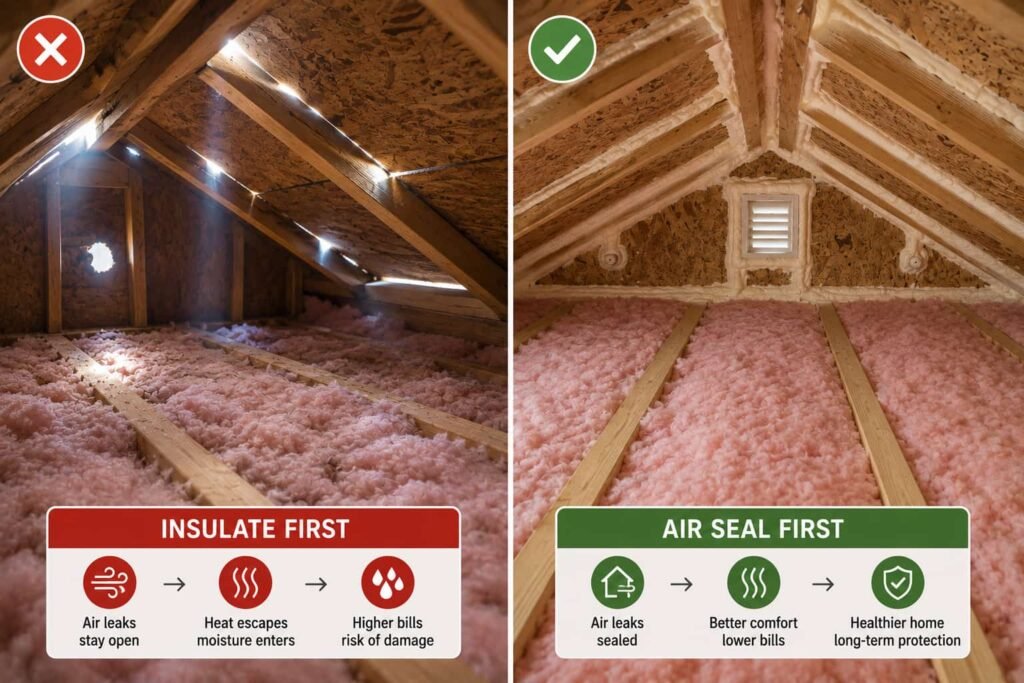
- Air sealing. Neither is an air barrier. The attic floor gets sealed first.
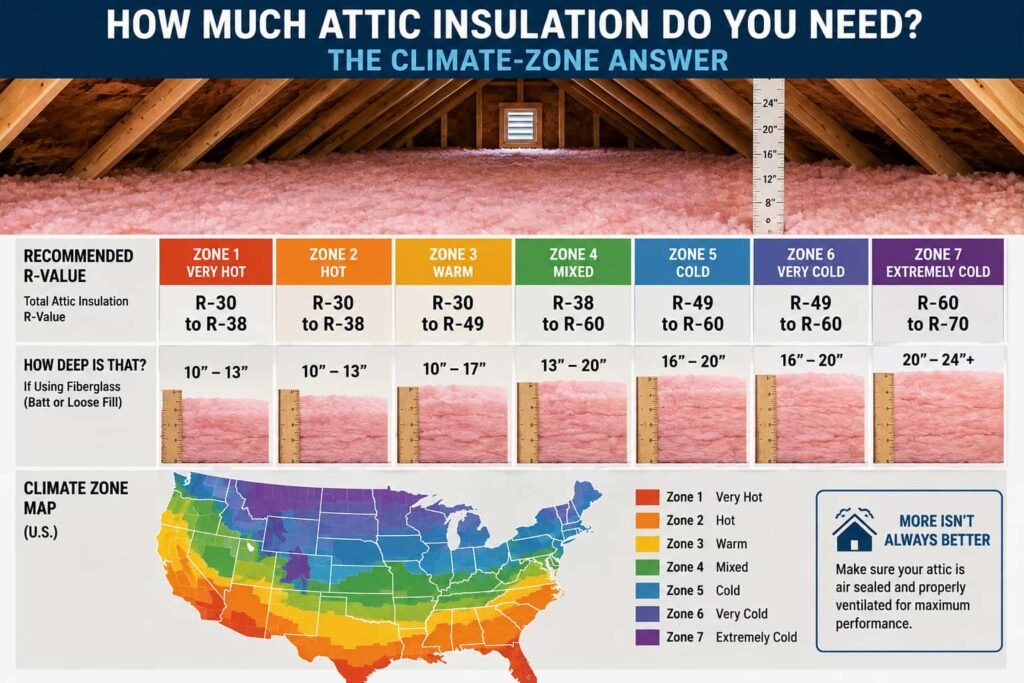
For the target depth, ENERGY STAR's recommended R-values by climate zone (read September 11, 2026) is the reference. Whether to blow loose fill or roll out batts is a separate question, covered in blown-in vs batt insulation for an attic you do yourself.
The problem is a closed wall
For walls you are not opening, the choice is between dense-packed loose fill and an injection foam, and it is a contractor's job. Cellulose is the material most often associated with dense-pack, because its fibers pack tightly and resist settling in a vertical cavity when blown to the manufacturer's dense-pack density. Fiberglass products made for dense-pack also exist.
The material matters less than the installer's checks: wiring, blocking, lead paint and verification that every bay filled. Ask for the manufacturer's data sheet and the density the contractor will blow to.
The problem is open framing or a noisy room
When the studs or joists are open, batts are the practical form, and the choice is usually fiberglass or mineral wool.
Mineral wool batts are stiffer and denser than fiberglass batts. That makes them easier to friction-fit into a bay without sagging, and it is the reason they are often chosen for interior walls and floors where sound is the complaint. If sound control is the goal, check the product's own acoustic test data. The fiber alone does not make a wall quiet; air gaps, outlet boxes and how the drywall is attached matter as much.
Fiberglass batts are lighter, widely stocked and cut easily. Their weakness is fit. A batt that is compressed around a pipe or left with gaps at the edges does not deliver its labeled rating. Where the framing is open over a garage, fit and fire separation both matter, as covered in insulating a garage ceiling under a bedroom.
The problem is a damp basement or a rim joist
This is where the three fibers are the wrong answer against the cold surface. Fibrous insulation lets air and moisture through it. Placed directly against a concrete wall that is cold and slightly damp, it can hold moisture against the wall with nothing to stop indoor air reaching the cold surface.
The usual approach against concrete is rigid foam board, sealed at the edges, with any framed wall and fibrous insulation inside it. We cover that in basement wall insulation with rigid foam. The rim joist at the top of the wall has the same problem, and the options are in insulating a rim joist with rigid foam or spray foam.
Safety when handling any of them
All three shed fibers or dust. ENERGY STAR's tips for working in the attic (read September 11, 2026) call for a particulate respirator or double-strap dust mask to prevent inhalation of hazardous substances, and a lightweight disposable coverall, gloves and hat to keep irritating insulation off your skin. Add eye protection. The manufacturer's safety data sheet for the product you buy governs handling.
One material is not a choice at all. If an attic already holds pebble-like, gray-brown or silver-gold loose fill, the EPA's guidance on vermiculite insulation (read September 11, 2026) says to assume it contains asbestos and not to disturb it. Do not blow anything over it or dig into it until a professional has dealt with it.
What none of them will do
No fibrous insulation stops air leaks, stops a roof leak or fixes a wet crawl space. Each works only at the thickness and density its maker specifies, and each loses ground when compressed, wet or soiled. Comparing them by "R-value per inch" misses the point on an attic floor, where depth is rarely the limit. The labeled R-value at the installed depth is the number that counts, and it is on the bag.
Frequently asked questions
Which has the highest R-value?
Compare the labeled R-value at the thickness you will install, not per-inch claims. Every product states the depth, or the settled depth for loose fill, that reaches a given R-value. Two materials installed to the same labeled R-value perform to that rating.
Is cellulose a fire risk because it is paper?
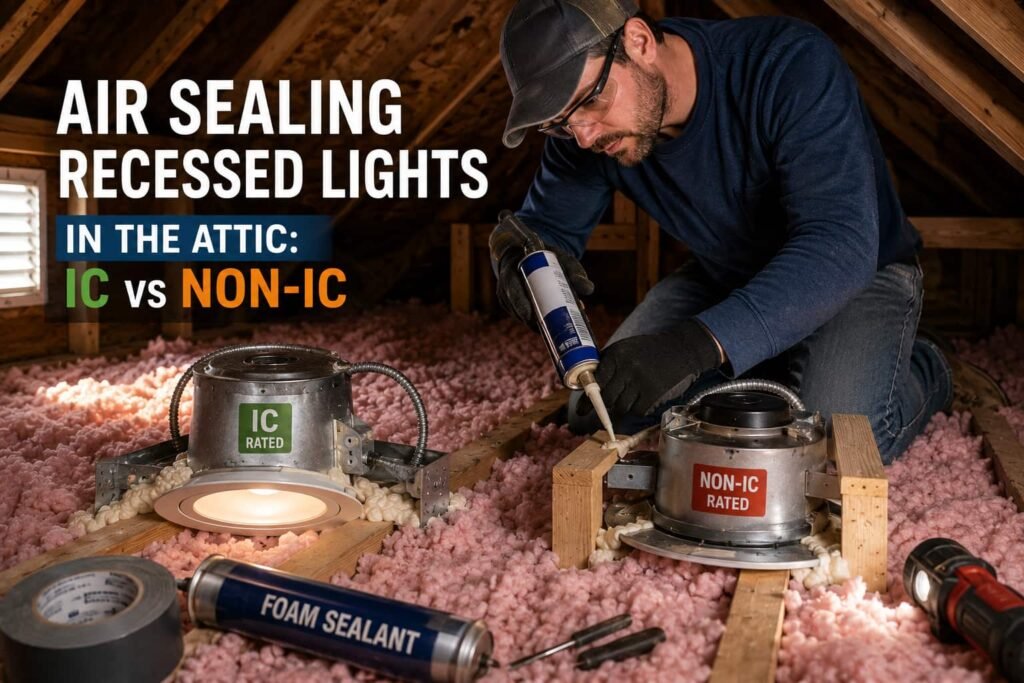
Cellulose sold for consumer use must meet the CPSC flame resistance and corrosiveness standard, and the bag must say so. Clearance rules around flues, chimneys and non-IC recessed lights apply to every insulation type, not just cellulose.
Does mineral wool need a vapor retarder?
That depends on your climate zone and the assembly, not on the fiber. Local code governs.
Can I mix materials, for example cellulose over old fiberglass?
Adding loose fill over existing dry, clean insulation is common. Check the old material first and use unfaced product for any added layer. The wet, soiled and vermiculite cases that rule this out are the ones to look for before you add anything.
Sources
- US DOE Building America Solution Center, "Loose-Fill Insulation": material descriptions; settling of cellulose 10 to 20 percent and fiberglass and rock wool 2 to 4 percent; fluffing below manufacturer's minimum density. Read 2026-09-11.
- 16 CFR 1209.9, CPSC interim safety standard for cellulose insulation, labeling requirement. Read 2026-09-11.
- ENERGY STAR, "Tips for Working in the Attic": respirator and protective clothing. Read 2026-09-11.
- ENERGY STAR, "Recommended Home Insulation R-Values," based on 2021 IECC Table R402.1.3. Read 2026-09-11.
- US EPA, "Protect Your Family from Asbestos-Contaminated Vermiculite Insulation." Read 2026-09-11.
Manufacturer data sheets and installation instructions govern any product used. Local code adoption varies.